



















Oil prices eased slightly after their biggest gains in about a month, as uncertainty over the status of peace talks between the United States and Iran increased the risk of reduced energy flows from the Arabian Gulf for a longer period.
Brent crude for August delivery approached $94 a barrel after rising 4.2% in the previous session, while West Texas Intermediate crude traded near $91 a barrel. Prices jumped on Monday following a report that Tehran had suspended talks with Washington in protest against Israeli attacks in Lebanon, before paring gains after US President Donald Trump stated that negotiations were continuing.
The US president said a memorandum of understanding with Iran to reopen the Strait of Hormuz could be finalized next week, according to a telephone interview with ABC News. He added that Washington still needs a few more points before an agreement can be reached.
The future of energy flows through the Strait of Hormuz
The lack of clarity regarding the potential extension of the current ceasefire and the future of energy flows through the Strait of Hormuz has led to volatility in oil prices, which fell last month amid optimism about a possible agreement. A report by the semi-official Tasnim news agency also stated that Tehran and its proxies in the region are considering a complete closure of the Strait of Hormuz, as well as the Bab el-Mandeb Strait at the southern end of the Red Sea, a vital alternative for oil exports.
“As long as flows through the Strait of Hormuz do not fully return to normal and the negotiation process between the United States and Iran remains uncertain, oil prices are likely to remain high and volatile,” said Lin Tran, a market analyst at XS.com in Ho Chi Minh City, Vietnam.
Adding to the confusion, Trump and Israeli Prime Minister Benjamin Netanyahu offered conflicting accounts of a phone call regarding the fighting in Lebanon. The Lebanese presidency stated in a post that the US-brokered ceasefire between Tel Aviv and the Iranian-backed Hezbollah should be extended from Beirut to encompass all of Lebanon, with further negotiations scheduled for Tuesday and Wednesday.
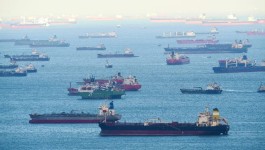
The primary focus in the oil market remains the vital Strait of Hormuz, through which roughly a fifth of the world's oil and liquefied natural gas supplies pass. Visible commercial traffic through the waterway has remained restricted since Friday, amid renewed diplomatic tensions between the United States and Iran, further increasing uncertainty in shipping.
In the latest trading, Brent crude futures for August delivery fell 0.9% to $94.24 a barrel by 1:22 p.m. Singapore time, while West Texas Intermediate crude futures for July delivery dropped 1% to $91.23 a barrel.