
































Oil prices jumped after the United States launched a wave of strikes against Iran in response to a series of attacks targeting cargo ships in the Strait of Hormuz, further escalating tensions in the energy-rich region.
Brent crude rose as much as 3% to surpass $76 a barrel, while West Texas Intermediate crude surpassed $72.
US Central Command said US forces conducted strikes on more than 80 targets following the attacks on the ships. Deputy Foreign Minister Kazem Gharibabadi warned that Tehran would retaliate. Axios reported that drones were launched toward Bahrain.
The US Treasury Department also revoked a sanctions waiver that had allowed Tehran to sell oil, backtracking on a key element of the interim peace agreement reached with Tehran.
These developments come after three ships were attacked in the waterway, including a gas tanker and a Saudi oil tanker, meaning that Tuesday saw the highest number of incidents since the agreement came into effect last month.
European natural gas futures also jumped, rising by as much as 4.9%.
Hormuz brings energy risks back to the forefront
The oil rebound, after futures plunged in the second quarter as regional tensions eased, threatens a new wave of turmoil in global energy markets.
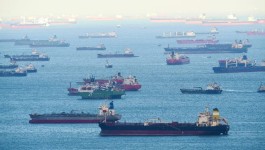
Attacks, whether against commercial vessels or retaliatory strikes by the United States, would complicate decisions facing ship owners and regional producers regarding navigation through the Strait of Hormuz , which connects Gulf suppliers to global markets.
According to ship tracking data, several vessels transited the strait in the hours following the attacks. Six loaded supertankers had begun or completed their transit, most sailing along a US-backed corridor close to the Omani coast.
Prior to these tensions, banks including Goldman Sachs Group warned that the crude oil market was at risk of returning to a surplus, as regional producers rushed to restore crude production and traffic through the strait increased. The OPEC+ alliance also continued to ease production restrictions.
Saul Kavonic, senior energy analyst at MST Marquee, said the escalation serves as a reminder to the market how fragile transit through the straits has been. He added: “This contradicts the prevailing sentiment that the market could be overwhelmed by oversupply and may prompt some traders to close their record short positions,” referring to the possibility of traders unwinding their bets on lower prices.
Expectations of renewed tensions
Control of the Strait of Hormuz is one of the main points of contention between Washington and Tehran. On Tuesday, Iran informed the UN shipping agency that it has authority over parts of the waterway, which in peacetime handles about one-fifth of the world's daily oil trade.
Carolyn Kissan, associate dean of the Center for Global Affairs at New York University, said that the gains in crude oil prices should be temporary unless further attacks occur. She added that the U.S. move sends a signal to Iran that it cannot act with impunity and without risking a return to full-scale hostilities.
She continued: This is the new normal; a ceasefire that isn't really a ceasefire, and we'll be seeing these kinds of events periodically. She added that the markets are already getting used to it.
The spread for the nearest Brent contract has reverted to a backwardation pattern, a bullish pattern where near-term prices are higher than longer-term prices. The spread reached 23 cents per barrel on Wednesday, a reversal from the 25-cent contango, the inverse structure, seen earlier in the week.