
































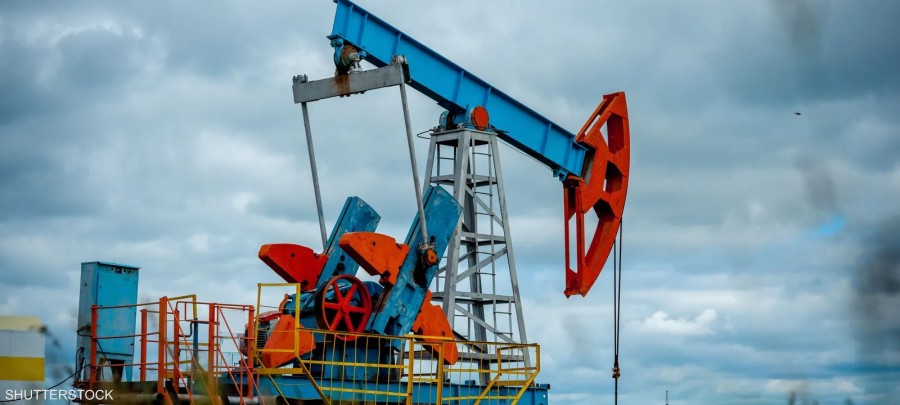


Oil prices continued to rise during trading on Wednesday, after US President Donald Trump reimposed a naval blockade on all Iranian ports, at a time when Tehran escalated its military operations by targeting US infrastructure in the region, increasing concerns about energy flows through the Gulf.
Brent crude futures rose 99 cents, or 1.2%, to $85.72 a barrel.
U.S. West Texas Intermediate crude futures also rose by 64 cents, or 0.8%, to $79.98 a barrel.
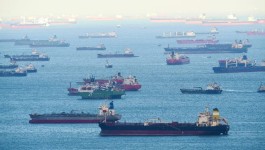
The Strait of Hormuz remains at the heart of the crisis.
These gains came after oil ended Tuesday's trading up by about 2% to its highest level in a month, as supply disruptions worsened in the Strait of Hormuz, through which about 20% of the world's oil and liquefied natural gas exports passed before the outbreak of the US-Israeli war on Iran.
Priyanka Sachdeva, senior market analyst at Phillip Nova, said that the physical oil market is still adequately supplied for now, but any further escalation in the Strait of Hormuz or new sanctions on Iranian oil exports could quickly change the equation and add new risk premiums to prices.
She added that markets are not only monitoring the current supply levels, but are also focusing on the potential for disruptions if military escalation in the region continues.
New US strikes and mutual escalation
The US military announced early Wednesday the start of a new wave of military strikes, asserting that they are aimed at reducing Iranian capabilities used to attack commercial ships transiting the Strait of Hormuz.
In response, Tehran announced that it had closed the strait again, following renewed military confrontations with the United States last week, which undermined the fragile truce reached in June after months of fighting.
As US President Donald Trump stated in an interview with Fox News, targeting Iranian energy facilities will come in the final stage, but he confirmed that the United States will target these facilities eventually.
Iranian attacks widen the circle of conflict
The Iranian military announced early Wednesday that it had launched drone attacks targeting US positions at the Azraq base in Jordan, while there was no immediate comment from the US Department of Defense.
Iran’s Revolutionary Guard also announced it had targeted weapons storage facilities and military installations in both Bahrain and Kuwait, although Reuters was unable to independently verify these reports.
This mutual escalation has raised increasing doubts about the future of the memorandum of understanding signed by the two sides last month, which was intended to put an end to the war whose effects have spread to a number of Iran’s neighboring countries.
Will oil jump to $100?
Tim Waterr, chief market analyst at KCM Trade, said the possibility of oil prices rising again towards $100 a barrel in the near term remains if the fighting continues and damages energy infrastructure in the Gulf region.
He added that Brent crude prices could stabilize in a range of $75 to $80 a barrel if diplomatic efforts succeed in reopening the Strait of Hormuz and resuming normal shipping traffic.
He explained that the risk premium is still included in oil prices, but it does not mean that prices will continue to rise in one direction, as both the United States and Iran still have strong incentives to return to diplomatic solutions and avoid widening the scope of the conflict.