





























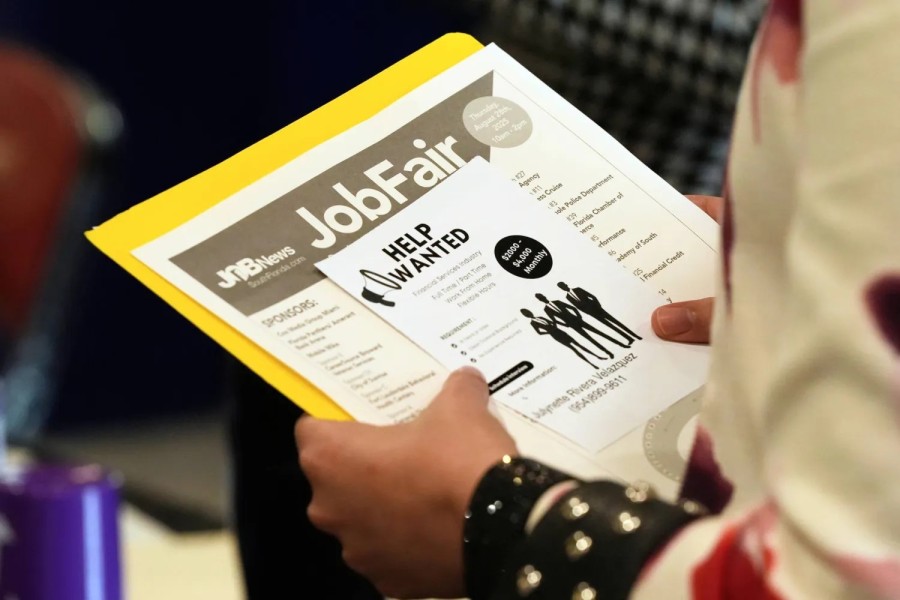


Job growth in the United States is expected to slow during June, but will remain at levels that reflect the strength of the labor market, while the unemployment rate is likely to hold steady at 4.3% for the fourth consecutive month, indicating continued relative balance in the US job market.
This expected slowdown comes after three consecutive months of strong gains that exceeded market expectations in the non-farm payrolls report, while investors await the release of the widely followed monthly report from the US Department of Labor, which contains indicators that could directly affect the Federal Reserve's decisions on interest rates.
The report is expected to keep the possibility of raising interest rates during the September meeting very much on the table, especially given the continued inflationary pressures resulting from the US-led war against Iran, which has raised the level of economic risks in recent months.
The report is scheduled to be released today, Thursday, instead of Friday, due to the national holiday during which the United States celebrates the 250th anniversary of independence, which falls on Saturday.
The labor market is entering a phase of neither widespread hiring nor large-scale layoffs.
Dan North, chief economist for the Americas at Allianz Trade, said he was concerned a few months ago after the economy lost jobs in five months, but the labor market has shown remarkable improvement over the past three months.
He added that the market is not currently suffering from any clear imbalances, describing the current situation as a phase of neither large-scale hiring nor large layoffs, as companies are avoiding large-scale expansion in hiring, and at the same time are not moving towards laying off workers on a large scale.
This situation reflects a degree of caution among companies, which prefer to retain their employees amid economic uncertainty, after facing significant difficulties in finding labor following the coronavirus pandemic.
Expectations of 110,000 new jobs in June
Economists expect the U.S. economy to add 114,000 jobs in June, compared with 172,000 jobs in May.
Forecasts ranged from the addition of just 25,000 jobs in the most pessimistic scenario to 200,000 jobs in the most optimistic scenario, reflecting the uncertainty preceding the report's release.
Economists estimate that the U.S. economy needs to add between 0 and 50,000 jobs per month just to keep pace with the growth of the working-age population.
This rate, necessary to maintain labor market stability, has decreased as a result of stricter immigration restrictions, which has slowed workforce growth and thus contributed to stabilizing the unemployment rate despite the slowdown in the pace of hiring.
The strength of employment surprised economists.
The US economy added about 214,000 jobs in March and 179,000 jobs in April, bringing the average number of jobs added during the three months ending in May to 188,000 per month, compared with just 63,000 jobs during the same period in 2025.
This sudden improvement has puzzled economists, as many of them have been unable to explain the reasons for the strength of the labor market despite the economic challenges.
But most analysts agreed that the historic low rates of layoffs were the main factor behind continued job growth.
Despite the uncertainty that began with tariffs last year and then escalated with the war in the Middle East, companies preferred to retain their employees rather than risk losing them, especially after the severe labor shortage they faced following the pandemic.
advertisement
Other indicators paint a less optimistic picture.
In contrast, the strength of the jobs data was not reflected in the rest of the labor market indicators.
Other surveys, including those of small businesses, have shown relative weakness compared to official job data.
A survey released by the Conference Board on Tuesday also revealed that the percentage of consumers who believe finding a job has become difficult rose to its highest level in nearly five and a half years during June.
James Knightley, ING's chief international economist, said the puzzling thing is that the official jobs data came in strong, while the rest of the labor market indicators did not show the same strength.
He added that there are concerns that the weakness reflected in company surveys will later begin to appear within the jobs data, if economic activity conditions continue to decline.
Have the risks of a labor market slowdown decreased?
Some economists believe that the risks that threatened the labor market have begun to recede, especially after the United States and Iran agreed to a ceasefire, which led to oil prices returning to their pre-war levels.
They believe that lower energy prices will ease pressure on businesses and the economy, supporting continued job growth in the coming period, with a wider base of sectors that are making gains in employment, instead of relying solely on the healthcare sector.
Shruti Mishra, an economist at Bank of America Securities, said that the downside risks that prompted the Federal Reserve to cut interest rates last year have not yet materialized.
She added that continued high inflation, coupled with a resilient labor market, strengthens the case for reversing those cuts and returning to raising interest rates.
Data from the US Interest Rate Monitor tool available on Investing Saudi Arabia indicates that markets are pricing in a probability of around 50.7% for an interest rate hike during the Federal Reserve meeting on September 15 and 16.
The Federal Reserve last month kept its key interest rate unchanged within the 3.50%-3.75% range, but showed in its quarterly projections that the majority of monetary policymakers still expect interest rates to rise during the current year.
World Cup and wages... factors that could change the picture
Economists believe that the expected slowdown in job growth during June may simply be a natural correction following the exceptional gains recorded by some sectors, most notably the local government sector, during the previous month.
Analysts were also divided on the impact of the United States, Canada and Mexico hosting the FIFA World Cup on the labor market.
Jobs in the entertainment and hospitality sector rose by 70,000 during May, and some economists believe the tournament contributed to this increase.
Economists at Goldman Sachs believe that historical analysis suggests the tournament could contribute to the addition of around 40,000 jobs during June, particularly in the entertainment and hospitality, professional services, trade and transportation sectors.
In contrast, JPMorgan analysts doubted that the tournament was the main reason behind the surge in hiring during May, arguing that the Memorial Day holiday, which came earlier this year compared to 2025, was the most influential factor, although they expect World Cup-related hiring to help mitigate any potential slowdown in June.
Wages could decide the Federal Reserve's decision.
Economists expect the labor market to continue to deliver steady wage growth, with average hourly pay rising 3.5% year-on-year in June, compared with 3.4% in May.
A number of analysts believe that the absence of strong wage pressures is one of the reasons that may prompt the Federal Reserve to hold off before tightening monetary policy further.
Veronica Clark, an economist at Citigroup, said that wage developments and the unemployment rate will be the two most important indicators for assessing whether the strength of employment is starting to lead to a new tightening of the labor market, which would increase pressure on wages and inflation.
She added that current indicators still show limited signs of such a scenario occurring, which makes the upcoming jobs report a crucial element in determining market expectations regarding the Federal Reserve's next move.