














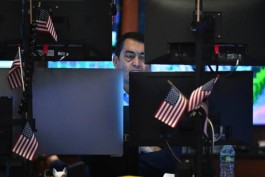



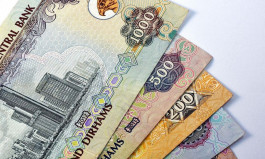
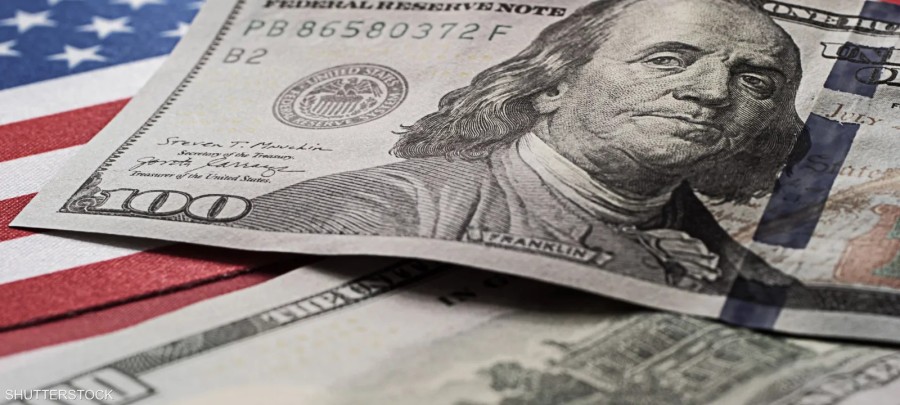
The dollar briefly rose to a seven-week high before settling against a basket of currencies during trading on Tuesday, before paring its gains as oil prices fluctuated.
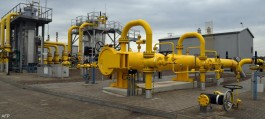
Crude oil prices fell after Japan's Kyodo News reported that Iran offered to reopen the Strait of Hormuz within seven days if the United States took steps to ease military pressure.
The earlier rise in oil prices, which reflected continued shipping risks, had supported the dollar, benefiting from the United States being a net exporter of oil, as well as the US currency's role as a safe haven.
Meanwhile, markets are betting on further US interest rate hikes after the US Federal Reserve raised interest rates by a quarter of a percentage point last week and indicated the possibility of taking further steps.
The dollar index DXY rose 0.1% to 100.514, after earlier hitting a high of 100.667.
The euro may continue to decline amid the possibility that the European Central Bank will pause interest rate hikes.
The euro faces the risk of further declines, with the European Central Bank likely to keep interest rates unchanged in October, according to ING's Francesco Pisole in a note.
European Central Bank officials have so far kept the option of raising interest rates in October firmly on the table.
Bisole said: “However, investors appear increasingly willing to embrace the opposite narrative, suggesting further downward pressure on the euro against the dollar in the near term.”
Meanwhile, the short-term fair value of the euro, based on ING’s 60-day model, fell below $1.15 for the first time since late July.
ING believes the euro could fall below its June lows of around $1.1320-$1.1330 in the near term.
The euro fell 0.1% to $1.1456, after earlier hitting a seven-week low of $1.1433, according to LSEG data.
The yen is under pressure as central banks worldwide move towards tighter monetary policy.
The yen came under pressure against a strong dollar on Tuesday, as traders bet that Japan's policymakers are struggling to keep pace with the shift toward hawkishness by central banks around the world, keeping interest rates in Japan at a wide gap compared to their major counterparts.
Trading was limited by a holiday in Japan, as well as by the risk of intervention in the currency market, after the Nikkei newspaper reported that Japan had checked the dollar-yen exchange rate on Friday. Such a move is often a precursor to market intervention.
After falling on Monday, the yen traded at 157.33 against the dollar early on Tuesday, while broader financial markets were supported by lower oil prices.
Apart from the yen's rebound following the exchange rate check report, the yen has remained under pressure since the Bank of Japan's interest rate hike on Friday was accompanied by opposition from two dovish members.
This contrasts with the US Federal Reserve, which also raised interest rates last week, as well as most other major central banks around the world, which are adopting a more hawkish tone, as markets price in further interest rate hikes this year.
Markets are currently pricing in about a 30% probability that the Bank of Japan will raise its short-term key interest rate to 1.5% in October, while they estimate about a 55% probability that the Federal Reserve will raise its target range for the federal funds rate by 25 basis points to a range between 4% and 4.25%.

UAE's Mubadala leads a $400 million financing round for German insurance company Wefox
Wefox, an insurance technology company founded by former emp.. Read more

Saudi Arabian Centers distributes dividends to shareholders for the second half of 2022 with a total of 356.25 million riyals
Arabian Centers Company has approved the distribution of cas.. Read more

The largest sovereign funds: "Abu Dhabi Investment Authority" advances to third place globally, with assets of $708.8 billion
The Abu Dhabi Investment Authority has advanced to the third.. Read more
Accumulated losses place Emirati companies on the "second category" screen, pending anonymity
Special Report - (Namazone): A group of companies listed.. Read more

Details 142 Saudi initiative to face the consequences of "Corona" B214 billion riyals
Special Report (Nmazzon): The government announced that.. Read more

Will gold remain a safe haven asset?
Gold has long been a source of controversy and contention am.. Read more
Global trade is expected to decline in the coming months
The economics department of Qatar National Bank (QNB) said t.. Read more

Analysis .. How will major central banks respond to the increasing cases of financial instability?
The global macroeconomic environment is experiencing some of.. Read more

The euro is below the dollar .. the lowest level in 20 years
For the first time in 20 years, the euro fell below $1 on Tu.. Read more

"OPEC"...The pressures of supply shortage will continue next year
OPEC expected global demand for oil to increase next year, b.. Read more
The dollar briefly hit a 7-week high as oil prices fluctuated.

NamaaZone " The Power of Knowledge"


Analysis Service |
Its a free service for technical consultation provided by NamaaZone to the website visitors. |
Open account Request |
NamaaZone provides a range of integrated trading solutions in local and global financial markets |