










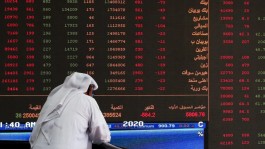




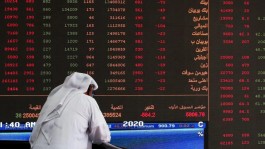



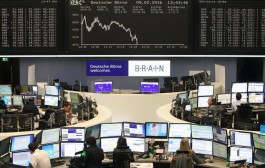













Oil prices jumped above $100 a barrel on Monday as the U.S. Navy prepared to impose a blockade on shipping to and from Iran through the Strait of Hormuz, a move that could restrict Iranian oil exports, after Washington and Tehran failed to reach an agreement to end the trade war.
Brent crude futures rose $6.67, or 7.0%, to $101.87 a barrel, after falling 0.75% in Friday's session.
Meanwhile, U.S. West Texas Intermediate crude rose by about $7.26, or 7.5%, to $103.83 a barrel, following a 1.33% loss in the previous session.
US escalation raises the stakes
Saul Kavonic, head of energy research at MST Markey, noted that the market has largely returned to pre-ceasefire conditions, but with the added factor of the United States’ intention to disrupt up to 2 million barrels per day of Iranian-related flows through the Strait of Hormuz.
US President Donald Trump announced on Sunday that the US Navy would begin imposing a blockade on the Strait of Hormuz, raising the level of escalation, especially after lengthy negotiations with Iran failed to reach an agreement, which threatens the fragile two-week truce.
He added that oil and gasoline prices could remain high until the midterm elections in November, in a rare acknowledgment of the potential political fallout from his decision to launch an attack on Iran six weeks ago.
Return of the geopolitical risk premium
Priyanka Sachdeva, senior market analyst at Phillip Nova, believes that the mere threat of implementing the blockade was enough to repric the risks in the markets, reflecting how sensitive oil prices are to geopolitical tensions.
Sachdeva explained that the return of prices to triple-digit levels reflects the return of the geopolitical risk premium, which had temporarily declined during the period of optimism surrounding the truce.
She emphasized that markets are once again treating the possibility of escalation as a key factor in determining price direction.
In this context, the US Central Command announced that forces would begin enforcing a naval blockade on all ships heading to or departing from Iranian ports, starting at 10 a.m. Eastern Time.
Central Command clarified that the blockade would be applied equally to vessels from all countries traveling to or from Iranian ports, including those on the Persian Gulf and the Gulf of Oman. However, it emphasized that freedom of navigation would not be affected for vessels transiting the Strait of Hormuz to non-Iranian ports.
Despite the failure of the first round of negotiations, markets are still betting on the possibility of reaching a solution regarding the strait before the end of June, according to Bjarne Schieldrop, senior commodities analyst at SEB bank.
Iranian responses and limited actions
Iran’s Revolutionary Guard warned that any military vessels approaching the Strait of Hormuz would be considered in violation of the truce and would be dealt with firmly.
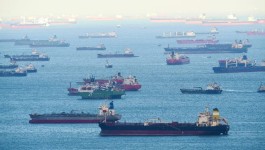
Despite the stalemate, shipping data showed that three fully laden supertankers transited the strait on Saturday, the first such movement since last week's ceasefire agreement. However, data also indicated that many oil tankers have begun avoiding the strait in anticipation of the US embargo.
In a parallel development, Saudi Arabia announced the restoration of its full oil pumping capacity through the East-West pipeline, reaching approximately 7 million barrels per day. This came days after assessing the damage inflicted on the energy sector by the attacks the Kingdom suffered during the conflict with Iran.