
























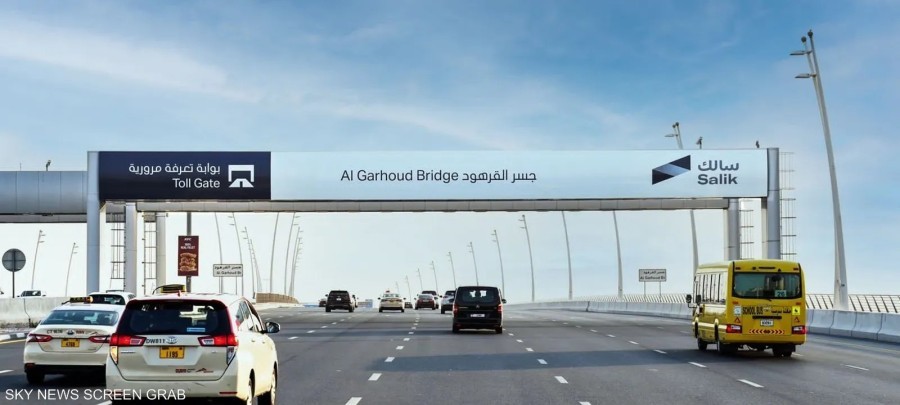

Salik, the exclusive operator of toll gates in Dubai and listed on the emirate’s financial market, announced revenues of AED 728.9 million for the first quarter ending March 31, 2026, a 3.0 percent year-on-year decrease compared to AED 751.6 million for the first quarter of 2025.
Meanwhile, net profit settled at AED 369.3 million, compared to AED 370.6 million, a slight decrease of 0.4 percent, with a net profit margin of 50.7 percent.
The company recorded earnings before interest, taxes, depreciation and amortization of AED 507.2 million, a decrease of 2.4 percent compared to AED 519.6 million during the first quarter of 2025, while the margin of these earnings increased to 69.6 percent, an increase of 143 basis points on a quarterly basis, and 44 basis points on an annual basis.
The company explained that the decline in revenues was mainly due to a decrease in revenues from toll system usage fees as a result of reduced traffic during the period, due to the exceptional event that affected the performance in March, with partial compensation from growth in Salik card activation fees and additional revenue sources.
The total number of trips through Salik gates reached 197.2 million trips during the first quarter of 2026, a decrease of 6.4 percent compared to 210.8 million trips during the first quarter of 2025, and a decrease of 12.1 percent compared to 224.3 million trips during the fourth quarter of 2025, while the total number of trips subject to tariff fees reached 145.7 million trips, a decrease of 7.7 percent annually and 13.6 percent quarterly.
Peak-time trips, subject to a 6-dirham fare, recorded approximately 53.7 million trips, a growth of 36.6 percent year-on-year, while off-peak trips, subject to a 4-dirham fare, reached 75.9 million trips, a decrease of 29.4 percent, and post-midnight trips, which are exempt from fees, reached 16.2 million trips, a growth of 44.6 percent.
The number of active registered accounts increased by 7.5 percent year-on-year to reach 2.8 million accounts, 14 months after the implementation of the flexible toll system on January 31, 2025.
Mattar Al Tayer, Chairman of the Board of Directors of Salik, affirmed that the results of the first quarter of 2026 reflect Salik’s ability to achieve consistent performance in a challenging operating environment, which confirms the strength and resilience of the company’s business model based on recurring revenues and vital traffic infrastructure in the Emirate of Dubai, along with its continued commitment to achieving long-term sustainable value for shareholders.
He said that Salik recorded a strong financial performance despite operational and economic challenges, with net profits reaching AED 369.3 million, achieving a net profit margin of 50.7 percent, driven by efficient cost management and the flexibility of the business model, noting that the company continues to develop additional revenue streams, enhance strategic partnerships, and employ advanced technologies.
For his part, Ibrahim Sultan Al Haddad, CEO of Salik, said that the company recorded a strong performance during the first quarter of 2026, with revenues reaching AED 728.9 million, the total number of trips reaching 197.2 million, and the number of active registered accounts increasing by 7.5 percent to 2.8 million accounts, with a profit margin before accounting for finance costs, taxes, depreciation and amortization of 69.6 percent.
He added that the company continues to develop its strategy beyond its core toll collection business, by expanding its Salik e-portal and strengthening its partnerships in the field of digital mobility, including collaboration with Emaar Malls, Parkonik and Liva, the ten-year agreement with Dubai Airports, and collaboration with Valtrans to enable digital payment for parking services starting in June 2026.
Revenues from traffic toll system usage fees amounted to AED 625.5 million during the first quarter of 2026, compared to AED 665.6 million in the same period of 2025, a decrease of 6.0 percent. Meanwhile, fines revenues amounted to AED 69.1 million, an increase of 1.0 percent, and contributed 9.5 percent of total revenues, compared to 9.1 percent in the fiscal year 2025.
Salik card activation revenues rose 6.1 percent year-on-year to AED 12.2 million, supported by an 8.4 percent growth in the number of registered vehicles, with card activation fees contributing 1.7 percent to total revenues.
The total additional revenue streams amounted to AED 8 million, an increase of 147 percent year-on-year, supported by parking solutions within partnerships with Emaar Malls, Parkonik and Dubai Airports, where Salik solutions were integrated into the parking systems of Terminals 1, 2 and 3 and the cargo building at Dubai International Airport as of January 22, 2026, along with the additional momentum in Salik’s partnership with the Leva Group.
Other revenues amounted to AED 22.1 million, compared to AED 6 million during the first quarter of 2025, an increase of 265.6 percent, while net financing costs amounted to AED 65.1 million, a decrease of 14.6 percent on an annual basis.
Profit before taxes amounted to AED 405.8 million, compared to AED 407.2 million, a slight decrease of 0.4 percent, while earnings per share amounted to AED 0.0492, compared to AED 0.0494 in the same period last year.
Salik recorded free cash flow of AED 636.5 million during the first quarter of 2026, an increase of 1.6 percent compared to AED 626.7 million during the first quarter of 2025, with a free cash flow margin of 87.3 percent, an increase of 394 basis points compared to 83.4 percent in the same period last year, and 1,330 basis points compared to the previous quarter.
Net cash flow from operating activities amounted to AED 636.5 million, while net cash generated from investing activities amounted to AED 508.1 million, compared to cash use of AED 497.5 million during the first quarter of 2025. Net cash used in financing activities amounted to AED 46 million, compared to AED 51.6 million.
At the financial center level, total assets reached AED 8.430 billion on March 31, 2026, compared to AED 7.872 billion on December 31, 2025, an increase of 7.1 percent, while cash and cash equivalents amounted to AED 1.612 billion, an increase of 214.1 percent quarterly and 54.8 percent annually.
Total liabilities amounted to AED 6.842 billion, compared to AED 6.653 billion at the end of 2025, an increase of 2.8 percent. Long-term loans and related party liabilities amounted to AED 5.833 billion, contractual liabilities amounted to AED 408.5 million, and equity amounted to AED 1.588 billion, an increase of 30.3 percent quarterly and 8.9 percent annually.
Net debt decreased to AED 4.226 billion at the end of March 2026, compared to AED 4.799 billion at the end of the fourth quarter of 2025, a decrease of 11.9 percent. The net debt-to-EBITDA ratio for the last 12 months was 1.98 times, compared to 2.24 times at the end of the fourth quarter of 2025, and less than the maximum debt limit of 5 times.
The company recorded a net working capital balance of negative AED 846 million, equivalent to 29.0 percent of annual revenues for the first quarter of 2026, compared to 20.5 percent in the fourth quarter of 2025, driven mainly by semi-annual payments for the franchise rights of the two new gates.
As part of expanding additional revenue streams, Salik signed a strategic partnership agreement with Valtrans in April 2026 to integrate the Salik e-wallet as a payment option across more than 100 locations operated by the company in the country, including destinations in the retail, business and entertainment sectors.
In January 2026, Salik and Dubai Airports signed a 10-year agreement to enable seamless payment for vehicle parking within Dubai International Airport, across passenger terminals 1, 2, and 3 and the cargo terminal. The service was implemented as of January 22, 2026.
The company continues its collaboration with Schneider Electric and Vcharge to operate the next-generation electric vehicle charging network, expected to be launched from the third quarter of 2026, in addition to collaborating with ENOC Group to provide payment solutions for fuel and other services, with a pilot phase expected to be implemented in 4 to 5 stations during the second half of 2026.
Salik also expanded its partnership with Parkonic through a five-year agreement, with operations commencing in more than 150 of the more than 200 locations within Parkonic's portfolio, while its partnership with Liva Auto Insurance recorded revenue growth of 58 percent on a quarterly basis.
In November 2025, Fitch Ratings raised Salik’s long-term foreign and local currency credit rating from A- to A, while in December 2025 Moody’s affirmed the company’s long-term credit rating at A3.
At the human resources level, the number of full-time employees of Salik increased by 11.1 percent year-on-year to reach 60 employees, and the number of nationalities within the workforce reached 14 nationalities compared to 12 nationalities a year ago, while the localization rate increased to 35 percent compared to 29.6 percent, and the representation of women in the workforce reached 23.3 percent compared to 20.4 percent a year ago.