

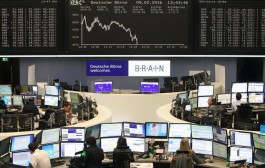











European stocks were relatively stable on Wednesday, as a wave of strong earnings reports from major banks, luxury goods companies and European mining firms helped offset the fallout from the military escalation in the Middle East, which pushed oil prices up by 3%, as well as a sharp sell-off in global technology stocks.
The pan-European STOXX 600 index rose 0.1% in early trading.
Germany's DAX index rose 0.2%, while France's CAC 40 index climbed 0.3%. The UK's FTSE 100 index gained 0.4%, while Spain's IBEX 35 index remained virtually unchanged.
In the banking sector, Standard Chartered raised its full-year revenue targets following a strong surge in its wealth management division that helped it beat profit expectations, sending its shares up 3%. Swiss giant UBS also exceeded net profit forecasts for the second quarter, while Spanish bank CaixaBank surpassed its fourth-quarter earnings estimates.
In the luxury and consumer goods sectors, Kering shares rose 9% after its flagship brand Gucci reported a smaller-than-expected decline in quarterly sales.
Eyewear giant EssilorLuxottica beat first-half earnings expectations with a 2.2% increase, while mining giant Rio Tinto posted its highest first-half profit in four years with a 2.5% gain. Healthcare company GSK raised its full-year profit margin forecast and announced plans for a $2.5 billion restructuring program.
However, the strength of corporate balance sheets was not enough to fully shield the indices from macroeconomic pressures. Fixed-income markets remained under considerable pressure, with high sovereign bond yields reflecting widespread investor anxiety ahead of the US Federal Reserve's monetary policy decision later in the day.
Although the Federal Reserve is widely expected to keep benchmark interest rates unchanged, financial markets are pricing in a one-in-three probability of a surprise rate hike or hawkish future guidance, driven by persistent inflation concerns, new trade tariffs, and rising energy prices.
Market sentiment deteriorated overnight following joint US-Saudi airstrikes targeting Iranian-backed groups in Iraq, accused of being responsible for recent drone attacks on Saudi oil facilities.
Tehran warned that attributing the attacks to Iran was a grave miscalculation, sparking a new wave of risk aversion. Energy markets reacted swiftly, with Brent crude oil prices jumping more than 3% after Iranian ballistic missiles were intercepted in regional airspace, reviving fears of prolonged supply disruptions and rising energy inflation.
Adding to the geopolitical tensions was a decline in European technology stocks, in line with a sharp sell-off in the Asian semiconductor sector triggered by SK Hynix's failure to meet quarterly operating profit expectations.
The disappointing results for this key AI memory supplier have reignited broader market concerns about high AI valuations, inflated capital expenditure budgets, and the ability of technology companies to exceed high expectations by wide margins.
The decline in semiconductor stocks comes at a sensitive time for global stock markets, with Wall Street giants Microsoft and MetaPlatforms set to announce their quarterly results later today.
Geopolitical risks and tensions related to the technology sector were casting a shadow over an unusually busy schedule of major earnings results from European companies.