












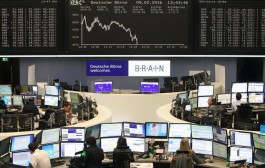














Oil rose to its highest level in over a month, and bonds fell as US and Iranian attacks escalated, renewing inflation fears. Stocks stabilized after a tech-led sell-off rocked markets last week.
Brent crude rose as much as 3.8% to $91.42 a barrel, its highest level since June, amid tit-for-tat strikes that extended beyond military targets.
Ten-year Treasury futures fell by 7.32%, with cash market trading closed during Asian hours on Monday due to a holiday in Japan. Government bonds in Australia and New Zealand also declined amid concerns that rising oil prices could fuel inflation.
Stocks performed mixed. Nasdaq 100 futures rose 0.3% after Friday's sell-off, which was partly triggered by a surprise breakthrough by Chinese AI startup Moonshot AI, after it unveiled a model that challenged perceptions of US leadership in artificial intelligence.
The MSCI Asia Pacific stock index fluctuated between slight gains and losses, while South Korea's Kospi index fell 4% as traders returned from Friday's holiday.
The escalation in the Middle East is unsettling markets already shaken by a sell-off in technology stocks, with investors wondering whether the AI spending boom can sustain the sector's rapid gains.
The rise in oil prices also brings inflation back into focus, after recent mild US data eased expectations that the Federal Reserve would need to raise interest rates.
Oil brings inflation risks back to the forefront
Sharu Chanana, chief investment strategist at Saxo Markets, said: “Asia remains fragile, as rising oil prices revive inflation risks, push yields higher, and tighten financial conditions for energy-importing economies. The sharp volatility in Korea also shows that the de-risking of AI and semiconductors is not over.”
Elsewhere, gold continued its decline from last week, falling 0.1% to around $4,000 an ounce. Rising oil prices reinforced expectations that interest rates will remain high for longer, making gold, which does not offer a yield, less attractive. The dollar's performance was mixed against major currencies.
The yield on Australian 10-year government bonds rose six basis points to 4.96%.
The widely followed Philadelphia Semiconductor Index also entered a bear market on Friday, after being shaken by Chinese startup Moonshot AI.
“In the long run, the real threat to South Korea’s memory chip trade comes from China,” said Homin Lee, chief macro strategist at Lombard Odier, in an interview with Bloomberg Television.
He added: In the second half of the year, we will see a partial shift in the narrative in favor of the Chinese AI and semiconductor ecosystem, which will lead to the expected massive listings, which the authorities seem to strongly support.
Meanwhile, oil gains came after US reports last week showed that consumer prices fell in June for the first time in six years, and that a key measure of core inflation was little changed.
Interest rate bets are on the strength of the US economy.
Earlier this month in Sintra, Portugal, Federal Reserve Chairman Kevin Warsh said that price risks had declined in recent weeks, and reiterated his determination to bring inflation back to the U.S. central bank's 2% target.
With Warsh making it clear that the central bank's priority is reducing inflation, traders will also be looking to this week's data for signs of resilience in the US economy, reinforcing expectations of an interest rate hike in September or October.
Futures markets are expecting roughly two interest rate hikes by the first quarter of 2027, and this expectation is underscored by strong support from hawkish members of the Federal Reserve, Vishnu Varathaan, head of macro research for Asia excluding Japan at Mizuho Bank, wrote in a note to clients.
He said: What could exacerbate the market downturn is the persistent, hardline bets on the Federal Reserve under Warsh's leadership.