













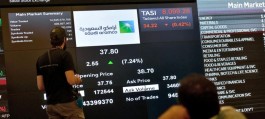





















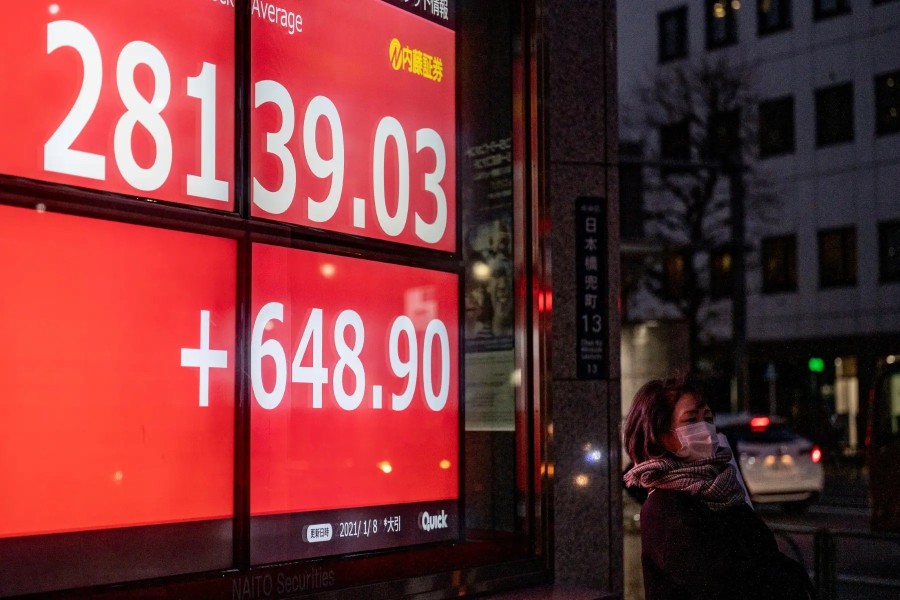


Asian stocks rose to a record high, with cheaper valuations and regional growth prospects attracting investors to broaden their focus beyond US markets .
The MSCI Asia Pacific Index rose 1% to an all-time high, with most sub-sectors posting gains.
Asian stocks have outperformed the S&P 500 this year, even as the US index also hit a record high. Gold and silver have also pared their earlier losses after Citigroup issued a positive outlook for the precious metals.
The bulk of the moves were in Japan, where stocks jumped and government bond yields rose amid speculation that Prime Minister Sanae Takaichi might call for an early election.
Shares in defense and nuclear energy companies rose in what is known as the Takaichi trades, which helped drive stock gains, bond losses, and a weakening of the Japanese currency.
Read also: Goldman Sachs predicts a US economic recovery this year
Risks facing Asian stocks
Asian stocks, which remain relatively cheap even after three years of gains, face key risks this week in the form of US inflation data and a possible Supreme Court ruling on tariffs imposed by US President Donald Trump .
The momentum in stocks suggests that investors are looking beyond the United States, where renewed attacks from the Trump administration on the Federal Reserve have raised concerns about the central bank's independence.
David Chao, chief global markets strategist at Invesco Asset Management, which oversees assets exceeding $2 trillion, said: “Non-U.S. assets, such as European and Asian stocks, are likely to look more attractive, particularly because of cheaper valuations and the increasing unpredictability of U.S. foreign policy.”
Read also: Does the absence of an economic collapse negate the existence of a problem with Trump's policies?
Asian stocks are cheaper compared to US indices. The MSCI Asia Pacific index trades at about 15 times earnings, compared to about 22 times the S&P 500 and 25 times the Nasdaq 100, according to data compiled by Bloomberg.
US political tensions and their impact on global markets
In a related context, US Treasury bonds and the dollar index stabilized after declining during the US session, as the Trump administration escalated its attacks on the Federal Reserve.
Council Chairman Jerome Powell said on Sunday that the central bank had received grand jury subpoenas from the Justice Department, which included a threat of criminal charges.
Mark Cranfield, a strategist at Bloomberg Markets Live, said Asian stocks continued their recent strong rally, with additional support from investor concerns about the Powell and Justice Department case that is casting a shadow over U.S. markets.
He added that investors seeking an AI-related narrative are finding ample options in Asia, with Chinese, Korean, Japanese and Taiwanese companies at the forefront of developments.
Fund managers at major bond firms such as Pimco, PGIM, and DWS Group warned that Trump's attacks on the Federal Reserve contradict his stated goal of lowering interest rates. Instead, this pressure adds a risk factor to the markets that could push bond yields higher.
Markets are monitoring Trump's policies
The latest escalation between the Trump administration and the Federal Reserve comes as investors navigate a turbulent environment. The president has targeted credit card companies, homebuilders, and defense contractors, while also considering a U.S. role in the Iranian protests following the arrest of Venezuela's president earlier in January.
Late on Monday, Trump said he would impose a 25% tariff on any country that does business with Iran, sending oil prices soaring.
Chris Larkin of Morgan Stanley's eTrade said: After shrugging off geopolitical surprises last week, US markets are now focused on domestic political headlines. Unless further surprises emerge, markets are likely to shift their focus to earnings and inflation data.
Watch for US inflation data
The core U.S. consumer price index, which is a measure of underlying inflation because it excludes volatile food and energy costs, is expected to rise 2.7% in December compared to the previous year.
Meanwhile, the fourth-quarter earnings season in the United States is expected to kick off strongly later this week, with expectations of a healthy performance, according to Michael Kasper and Wendy Song of Bloomberg Intelligence.
Based on current estimates, S&P 500 companies are expected to achieve earnings growth of 8.4% in the fourth quarter and 14.6% in 2026. Excluding the Big Seven (Apple, Nvidia, Amazon, Alphabet, Meta, Microsoft, Tesla), earnings growth is expected to be 4.6% and 13.3% respectively.