











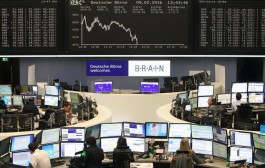







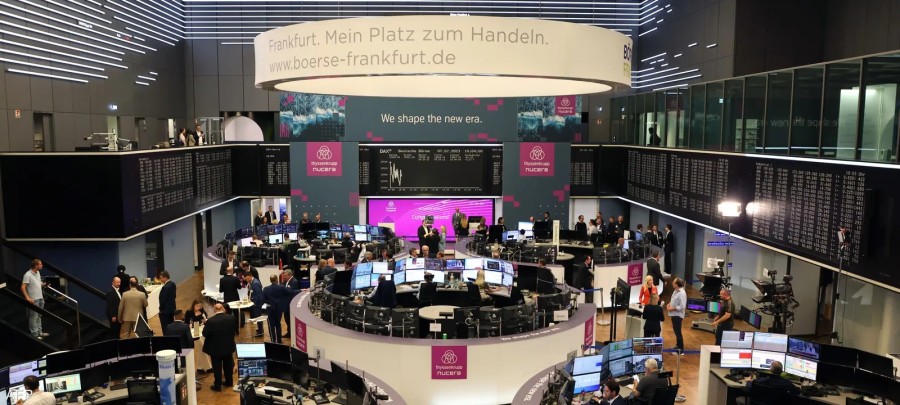


European stocks fell on Monday as growing uncertainty surrounding US trade tariffs dampened risk appetite at the start of a new week.
At 11:02 (Saudi Arabia time), Germany’s DAX index fell by 0.6%, France’s CAC 40 index declined by 0.2%, and the UK’s FTSE 100 index dropped by 0.1%.
Trump's tariffs hit morale
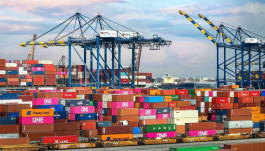
Global stocks, including major European indexes, received a boost late Friday when the U.S. Supreme Court struck down most of the tariffs imposed by U.S. President Donald Trump last year, finding that the emergency law he relied on did not allow the tariffs to be imposed.
However, using a different law, Trump responded over the weekend by first announcing global tariffs of 10%, then 15%, which could last for five months while the administration looks for more permanent alternative solutions.
The uncertainty resulting from trade policies that appear to be decided arbitrarily has affected sentiment.
European Central Bank President Christine Lagarde said on Sunday on CBS's Face the Nation: If that shakes up the perfect balance that people are used to in trading... it will lead to disruption. You want to know the rules of the road before you get in the car. The same applies to trading. The same applies to investing.
German Ifo index shows improved confidence
Confidence in Europe was on the rise, pushing the broad-based STOXX 600 index to a record high last week, supported by generally positive earnings as well as economic data that pointed to a gradual recovery in the region.
Data released on Friday showed that business activity in the eurozone accelerated faster than expected this month as manufacturing returned to growth for the first time since October.
Cyrus de la Rubia, chief economist at Hamburg Commercial Bank, said: It may be premature, but this could be a turning point for the manufacturing sector as the headline PMI has moved into growth territory.
The German Ifo business climate survey is due later in the session and is expected to show further improvement in sentiment in the Eurozone's dominant economy.
Nvidia stands out in weekly earnings
There are more important earnings to digest in Europe this week, including the likes of HSBC, Deutsche Telekom, Iberdrola and Schneider Electric, but the main release will come from across the ocean with chip giant Nvidia (NASDAQ:NVDA) scheduled to report its results on Wednesday.
Prior to that, PostNL cut its annual dividend by 43% and warned that free cash flow could turn negative again in 2026 as the Dutch postal group’s full-year free cash flow swung to a loss of €25 million from a profit of €12 million a year earlier, even as revenue rose 2.2% to €3.32 billion.
Almirall SA said its newly launched biologic eczema treatment Ebglyss tripled sales in its second year on the European market, pushing the Barcelona-based dermatology company past €1 billion in annual revenue for the first time.
Elsewhere, Rolls-Royce is urging the British government to commit to supporting taxpayers in the development of a new £3 billion jet engine as it seeks to re-enter the lucrative short-haul market, the Financial Times reported earlier on Monday.
Oil prices fall ahead of nuclear talks
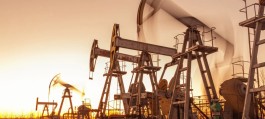
Oil prices fell sharply on Monday, giving up some of last week's gains as investors weighed the prospect of a third round of nuclear talks between the United States and Iran and renewed uncertainty from U.S. trade policy.
Brent crude futures fell 1.3% to $70.39 a barrel, and U.S. West Texas Intermediate crude futures dropped 1.4% to $65.55 a barrel.
Both contracts rose by approximately 6% last week due to concerns about a possible conflict between the United States and Iran, as well as an unexpected drop in U.S. crude oil inventories.
The two countries are now expected to hold a third round of nuclear talks on Thursday in Geneva, raising hopes for a diplomatic solution that would ease the risk of disruption to crude oil flows from the Middle East.
Iran is a major producer within the Organization of the Petroleum Exporting Countries (OPEC) and possesses some of the world's largest proven crude oil reserves.