


































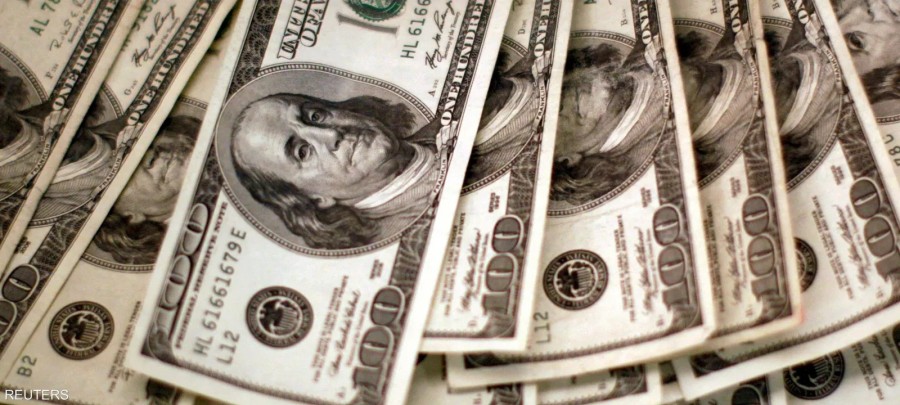


The US dollar rose on Tuesday, holding onto its gains following the release of the Federal Reserve's December meeting minutes, as investors tried to foresee the future course of monetary policy.
Year-end holidays kept trading volumes low, and analysts cautioned against over-interpreting recent market movements. Nevertheless, the dollar is on track for its worst annual performance since 2017, with a decline of nearly 10%. According to the minutes of the last two-day meeting, held on December 9 and 10, the Federal Reserve agreed to cut interest rates only after a thorough and careful discussion of the risks currently facing the US economy.
New projections released after the December meeting indicate that the Federal Reserve anticipates only one interest rate cut next year, while the revised wording of its monetary policy statement suggests the bank is likely to keep rates unchanged for now until new data confirms either a further decline in inflation or a larger-than-expected rise in unemployment. Markets are currently pricing in around 50 basis points of interest rate cuts next year.
Joseph Trevisani, senior analyst at FX Street in New York, said: There is no clear direction for Federal Reserve policy, and this is reflected in the dollar and currency prices, as well as in interest rates and Treasury bond yields, so the markets don't have much data at the moment.
He added: “If we are looking for movements in the dollar, currencies, and perhaps even interest rates at the start of the new year, we will have to look at the performance of the economy and see if that will move these markets.” The dollar index, which measures the performance of the US currency against a basket of currencies, rose 0.19% to 98.19 points, while the euro fell 0.18% to $1.1751, but is still up more than 13% since the beginning of the year. Sterling fell 0.3% to $1.3467, but has made gains of nearly 8% against the dollar in 2025.
Overall, the dollar index has fallen 9.5% since the start of the year, marking its biggest annual decline in eight years. This drop is driven by expectations of interest rate cuts by the Federal Reserve, narrowing interest rate differentials with other currencies, and concerns about the fiscal deficit and political uncertainty, all of which have weighed on the US currency. With limited economic data available in most markets ahead of the New Year holiday, data released earlier on Tuesday showed that US home prices rose in October at their slowest annual pace in more than 13 years, according to the Federal Housing Finance Agency.
This was seen as a possible sign of improving housing affordability in the long-struggling housing market. The Japanese yen fell 0.2% against the dollar to 156.39 yen per dollar, although the Japanese currency had strengthened in recent days, moving away from levels that prompted Tokyo officials to make statements last week, increasing market expectations of possible intervention by the Bank of Japan.
The yuan surpasses an important psychological level
The Chinese yuan broke through the psychological level of 7 yuan to the dollar in the onshore market for the first time in two and a half years, defying weaker central bank guidance, as exporters rushed to sell dollars towards the end of the year.
The yuan hit 6.987 against the dollar, its strongest level since May 2023. The yuan has risen by about 4% against the weakening dollar since early April, when US President Donald Trump announced sweeping tariffs, and is now poised to end a three-year losing streak.
The People's Bank of China has sought to prevent the yuan from appreciating excessively through weaker price guidance and verbal warnings in state media, but has so far failed to reverse the yuan's strength. The Canadian dollar fell against its US counterpart by less than 0.1% to 0.7301 by 21:02 GMT.
Australian dollar
The Australian dollar was steady against its US counterpart at 0.6695 by 21:03 GMT.