






































In an interview with TIME magazine (conducted Monday and published Thursday, October 1), US President Donald Trump said that certain levels of inflation would pay off the national debt very quickly, when asked about the national debt exceeding $40 trillion and growing by nearly $11 trillion during his presidency. He did not specify an inflation rate or a timeline, saying he did not want to reveal the means and that the debt could be paid off by other means, pointing to growth. He also argued that interest rate policy was harming America more than inflation itself. The response from within his administration was swift: Kevin Hassett, Trump's chief economic advisor, denied in an interview with Bloomberg that the White House was planning to get out of the debt with inflation, saying, No, absolutely not. Between these two statements, the US 10-year yield closed at 5.24% after reaching 5.34%, its highest level since 2002.
Amid this debate, a question frequently asked by investors is: Can the rise in gold prices itself cover government debt?
The account: accurate and verified by the US Treasury itself.
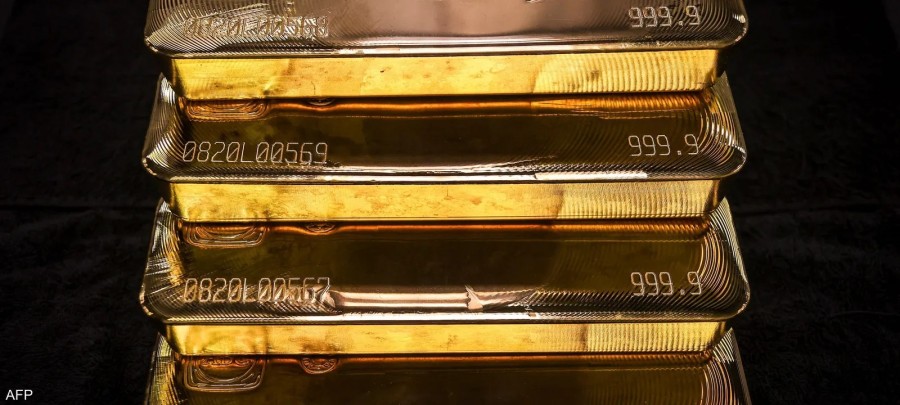
To fully cover the US federal debt (approximately $40 trillion) using only the official gold reserves (261.5 million ounces, officially confirmed by the US Treasury Department itself), the price per ounce would need to reach approximately $153,000—roughly 34 times the current price ($4,500). We independently verified this calculation and found it to be entirely accurate, matching a similar calculation performed independently by the specialized platform Discovery Alert.
The same logic applies to the Eurozone (debt of $16.2 trillion ÷ 346.6 million ounces = $46,730 required), and Russia (debt of $394.5 billion ÷ 75 million ounces = only $5,260 — meaning that Russia needs an increase of only 1.17 times the current price, given the relatively smaller size of its debt compared to its gold reserves).
The first problem: This is a thought exercise, not a practical, actionable plan.
Discovery Alert accurately describes this calculation as a thought experiment, not a prediction — its purpose is to show that U.S. gold reserves cover only about 3% of total federal debt at current market prices, not to suggest an actual plan to liquidate that gold.
The most important question: Why is there no harm in an inaccurate claim?
Herein lies the fundamental flaw in the logic of this argument. The common claim that rising prices do not harm any industry and that **no factories close, there is no crisis** ignores basic economic facts:
1. A surge of this magnitude (34-fold) is not an isolated economic event—gold at $153,000 an ounce cannot occur in a vacuum; it is either the result of a complete collapse in the value of the currency (hyperinflation exceeding any historical precedent) or a total crisis of confidence in the entire global financial system. In either case, the economic damage will be enormous—from the erosion of savings to the collapse of purchasing power to a complete disruption of the entire global supply chain, which is priced in dollars.
Two real industries will actually be affected: the jewelry and electronics sector (gold is a key component in microelectronic circuits) will face a 34-fold increase in production costs — and that is precisely the kind of industrial damage this argument denies.
3. The government does not actually pay off the debt in this way: even if the price theoretically rises to this level, actually selling 261 million ounces in the market to liquidate this value will inevitably lead to the price itself collapsing immediately (the basic law of supply and demand) — that is, the paper value on the chart is not equal to the actual achievable value when trying to sell it all at once.
What is the real and legitimate debate behind this idea?
There is indeed serious discussion about the accounting revaluation (not the actual sale) of U.S. Treasury gold—it is still recorded on the books at only $42.22 per ounce, a legal price unchanged since 1973 (a legacy of the Bretton Woods system), while its actual market value exceeds $1.2 trillion. A simple accounting revaluation of this reserve (not its sale) at the current market price could generate a substantial book profit that could be used for specific accounting purposes (such as partial financing or bolstering the Treasury budget)—but this is fundamentally different from the idea that a price increase to $153,000 solves the problem at no cost, as this proposal suggests.
Summary
The mathematical calculation is accurate and its source is reliable (official US Treasury data). However, the conclusion drawn from it—that such a significant rise in the price of gold is a cost-free and crisis-free solution—is a gross oversimplification that ignores the fact that such a high price would only occur as a symptom of a genuinely deep economic crisis, not as a smooth fix for it. The figure is useful as an illustrative measure of the gap between debt and gold reserves (currently only 3% of coverage), not as a serious economic policy plan or a win-win scenario as it is being portrayed.