






















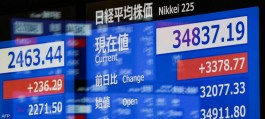
















Citigroup announced that it sees potential for global stocks to continue making gains, supported by solid earnings growth, despite a growing list of headwinds, including geopolitical tensions and rising interest rates, raising the question of whether markets are showing genuine resilience or simply underestimating the risks.
Strategists led by Beata Manthi said global equities have risen nearly 12% since the start of the year and are approaching all-time highs, putting the MSCI World Index on track for double-digit returns for the fourth consecutive year. Despite continued uncertainty, the bank affirmed that it is currently in the 'stay-ready' camp.
Citigroup's main outlook anticipates that geopolitical risks will subside before the end of the year, with global economic growth slightly below average. This sets the stage for slower but still robust earnings growth in 2027, which analysts say could support further gains. The consensus forecast predicts global earnings per share to grow by 16% in 2027, following 35% growth this year, with the technology sector accounting for the bulk of that growth.
The bank expects global equities to gain around 6% by year-end, with double-digit increases in most regions by mid-2027, driven by earnings growth rather than widening valuation multiples. Valuations have fallen by about 15% this year, leaving the MSCI AC World Index at roughly 16 times future earnings, at the 74th percentile of its 25-year history.
Analysts noted that the Federal Reserve's first interest rate hike causes market turmoil but rarely ends bull markets, adding that rising long-term bond yields are easily absorbed if economic growth remains robust. Citi economists believe global resilience remains firmly in place.
Analysts added that expansionary trading may remain stalled until the US-Iran conflict is resolved, but they continue to recommend a dual-edge approach that combines cyclical and growth stocks. Should tensions escalate in the near term, this would benefit the US, UK, commodities, and defense sectors.
Citi maintained its overweight recommendation for the US, Japan, and the global IT sector, where earnings momentum and AI-driven growth are at their peak, and added an overweight recommendation for the raw materials sector. Europe (excluding the UK) and emerging markets remain at a neutral rating. Citi downgraded its financial sector rating to neutral and its real estate sector rating to underweight, while upgrading its telecommunications services rating to neutral.
The bank acknowledged that there were ample reasons to expect near-term volatility, including the potential for escalating geopolitical tensions, the usual disruptions associated with the start of interest rate hike cycles, and the midterm elections.