





































Goldman Sachs Inc. predicted that Brent crude would continue to trade in a range of $80.00 to $90.00 per barrel until either a new agreement between the United States and Iran is confirmed, or there is a significant escalation in attacks and targets in the region.
Brent crude futures fell to lows of $80.00-$85.00 after the United States called off planned attacks on Iran to give negotiations a final chance, amid reports that Iran’s talks with Oman over the management of the Strait of Hormuz were in their final stages.
Goldman Sachs Inc. estimated the fair value of spot Brent crude prices at around $80.00 per barrel, based on the OECD's commercial inventories index, current demand estimates, and the historical relationship between inventories and spot prices. Strategists led by Yulia Gestkova-Grigsby noted that this means the market is pricing in only a moderate risk premium, despite continued high uncertainty surrounding Middle East supply.
Despite this, the physical oil market is experiencing increasing tightening. Goldman Sachs Inc.'s global visible inventories index showed a decline of 6.3 million barrels per day over the past two weeks, which the bank attributed to reduced flows from the Arabian Gulf and the Red Sea, lower Russian oil exports, and higher Asian imports, particularly to China.
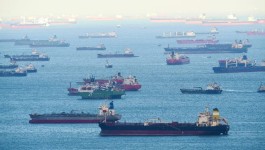
Gulf oil flows have fallen to 36% of pre-war levels, equivalent to about 9 million barrels per day on a seven-day moving average, a sharp decline from nearly 80% of pre-war levels in the first half of July. Total Red Sea flows through the Bab el-Mandeb Strait and the Suez Canal have also fallen by 1.7 million barrels per day on a weekly basis.
Saudi Arabia has offset some of this disruption by redirecting flows through the SUMED pipeline, which connects the Gulf of Suez to the Mediterranean Sea; flows to the pipeline's Ain Sokhna terminal have increased by 1 million barrels per day over the past week.
Russia's crude oil and condensate exports fell by 1.3 million barrels per day (bpd) over the past two weeks, following a shift in drone attacks from targeting refineries to targeting oil tankers in late June. Conversely, Asia's net crude oil and condensate imports rose by 5.6 million bpd during the same period, with China accounting for 2.3 million bpd of this increase. Goldman Sachs Inc. attributed this rise to the decline in crude oil prices in late June and early July.