




































Oil prices stabilized after a three-day rally, as the United States carried out another round of airstrikes on Iran after Tehran launched a series of attacks on ships this week.
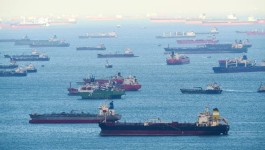
Brent crude, the global benchmark, traded below $85 a barrel after rising 12% over the previous three sessions, while West Texas Intermediate crude hovered near $80. The United States carried out further airstrikes against Iran, targeting a supertanker near Iran's main crude export terminal in the Arabian Gulf. Tehran had previously attacked ships in the Strait of Hormuz, alarming shipping companies and causing a decrease in detectable maritime traffic.
Crude oil prices jumped to their highest level in nearly a month as escalating conflict revived concerns about flows from the energy-rich region, erasing some of the nearly 30% drop seen in the second quarter. Meanwhile, near-daily Ukrainian attacks on Russian fuel production facilities and tankers are further threatening global supplies.
Jeff Currie, senior advisor at Carlyle Group Inc., told Bloomberg Television: “We have not only lost the entire Strait of Hormuz again, but we have also lost crude oil and refineries in Russia. I see the situation in the energy sector as very bad.”
US President Donald Trump vowed to intensify bombing of Iran until Tehran stops attacking ships in the Strait of Hormuz and agrees to reopen the vital energy chokepoint. The Wall Street Journal reported that Trump is inclined to expand military operations and has discussed seizing Kharg Island, which houses Iran's main oil export terminal.
Supply threats and the continued closure of the Strait of Hormuz
Tehran shows few signs of backing down. The Revolutionary Guard said on Wednesday that the strait would remain closed until the United States ends its strikes and blockade of Iranian ports.
Iran’s recent attacks on oil tankers also threaten what are known as ship-to-ship shuttles, a process in which crude oil is transferred from one ship to another outside the strait. This system has become a vital lifeline for countries including the UAE during the war, although any disruption is likely to be short-lived.
Analysts at RBC Capital Markets LLC, including Helima Croft, said the seven-day moving average of oil flows through the Strait has fallen by 4.6 million barrels per day to 3.9 million barrels per day since fighting resumed a week ago, reflecting the collapse of the ceasefire, renewed Iranian attacks, and the return of the US embargo.
They said that even if Trump opts for a strategic retreat, we do not foresee traffic in the Strait of Hormuz returning to pre-war levels as long as shipping companies have to contend with the threat of mines, missiles, drones, and fees that Tehran might impose.
Oil markets face a new reality
John Woods, chief investment officer and head of investment solutions for Asia at Lombard Odier, indicated in an interview with Bloomberg Television that markets may adapt to the situation rather than expect a return to normalcy.
He said: What we are likely to see in the current period resembles a semi-permanent, cyclical disruption to oil flows through the Strait, a reality that markets will have to accept. He added that the price of Brent crude may include a permanent premium of between $5 and $15 as the new normal.
Nevertheless, tanker traffic continued. Tim Hawkins, a spokesman for U.S. Central Command, said the number of U.S.-assisted transits reached double digits Tuesday night. Of the approximately 300 vessels that passed through the waterway last week, nearly half received assistance from U.S. forces.
Meanwhile, U.S. crude inventories fell by about 1.7 million barrels last week as oil exports rose, although they remain below pre-war averages, according to Energy Information Administration data released Wednesday.
Inventories in Cushing, Oklahoma, the delivery point for West Texas Intermediate crude, have risen above the 20 million barrel level seen as the operational minimum for the hub.
In the latest trading, Brent crude futures for September settlement fell 0.4% to $85.65 a barrel at 7:43 a.m. in London, while West Texas Intermediate crude futures for August delivery declined 0.1% to trade at $79.49 a barrel.