
















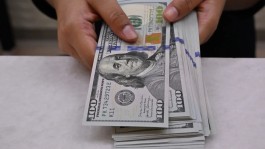


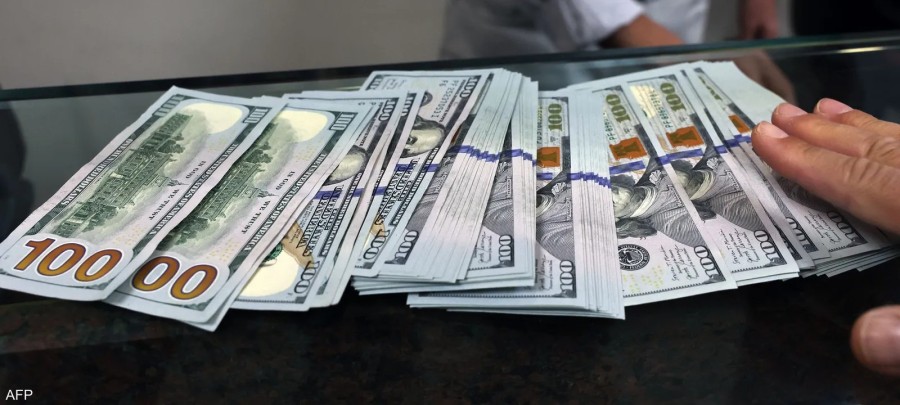
The dollar fell on Thursday, but remained above its recent lows after minutes from the Federal Reserve meeting showed policymakers were in no hurry to cut interest rates, and that many were open to raising them if inflation continued to rise.
Investors also expressed concern over reports of an increased US military presence in the Middle East and the possibility of a US-Iranian conflict, which led to higher oil prices and safe-haven assets.
Meanwhile, the euro settled at around $1.18, after falling sharply the previous day, following a report that European Central Bank President Christine Lagarde intends to leave her post before her term ends in October of next year.
Split in the Federal Reserve
Minutes from the Federal Reserve meeting released Wednesday showed a split among policymakers over the direction of U.S. interest rates, and indicated that the new president, scheduled to take office in May, will have difficulty passing interest rate cuts.
The minutes stated that many policymakers expect productivity gains to curb inflation, but most participants cautioned that progress could be slow and uneven.
Many analysts have indicated that interest rates could be raised if inflation continues above the target level.
Peter Dragicevic, Asia-Pacific currency strategist at Corby, said: “This suggests there is no urgent need to cut interest rates again, at least not before the current chairman (Jerome) Powell’s term ends in May.”
Data released on Wednesday showed that U.S. factory output rose by the most in 11 months during January, along with increased capital spending and housing starts.
Markets are awaiting the release of the global Purchasing Managers' Index (PMI) and US GDP data, both scheduled for Friday.
The euro stabilized following speculation about Lagarde.
The euro rose slightly against most other currencies, after stabilizing following a sell-off triggered by speculation that Lagarde might leave the European Central Bank early, which would give outgoing French President Emmanuel Macron a say in choosing her successor, according to the Financial Times.
Her term is scheduled to end in October 2027, and her potential successors are not expected to make a radical change in monetary policy, but these speculations have emerged in conjunction with the crystallization of a change in the leadership of the Federal Reserve.
Terry Wezeman, foreign exchange and global interest rate strategist at Macquarie Group, said: Given the number of countries involved in the negotiations and the various ECB vice presidents, a change of Fed chair may be more significant than a change of ECB president in terms of the subsequent direction of monetary policy.
He added: And it could easily be replaced by a more lenient or more hardline figure. It's not clear which, as there are no real frontrunners. I think that's why the market hasn't paid much attention to this news.
The yen weakened and the Australian dollar stabilized.
Meanwhile, the yen weakened overnight, posting a decline for the second day in a row, after the Trump administration announced $36 billion in projects as the first investments under Japan’s pledge to invest $550 billion in the United States.
The Japanese yen was trading slightly lower at 154.96 against the dollar, after losing 1.5% of its value this week.
Chris Turner, head of global research at ING, said: “Japanese direct investment in the United States will be a key factor to watch this year, which is increasing the volatility of the USD/JPY pair.”
The question facing foreign exchange markets this year is whether this investment will help support the flow of dollars, or whether Japan’s foreign exchange reserves will be used to guarantee new dollar loans and avoid putting pressure on the yen.
The latter option seems to be the most likely for Tokyo.
The Australian dollar held steady at $0.7050 after employment data showed the unemployment rate remained at a multi-month low of 4.1%, while the New Zealand dollar rose 0.3% to $0.5982, after its biggest drop since last April, following the central bank's more cautious stance on future interest rate hikes than expected.
Holidays in Hong Kong, China and Taiwan slowed Asian trade, and the yuan's exchange rate stabilized at 6.9 against the dollar in offshore trading during European hours.

UAE's Mubadala leads a $400 million financing round for German insurance company Wefox
Wefox, an insurance technology company founded by former emp.. Read more

Saudi Arabian Centers distributes dividends to shareholders for the second half of 2022 with a total of 356.25 million riyals
Arabian Centers Company has approved the distribution of cas.. Read more

The largest sovereign funds: "Abu Dhabi Investment Authority" advances to third place globally, with assets of $708.8 billion
The Abu Dhabi Investment Authority has advanced to the third.. Read more
Accumulated losses place Emirati companies on the "second category" screen, pending anonymity
Special Report - (Namazone): A group of companies listed.. Read more

Details 142 Saudi initiative to face the consequences of "Corona" B214 billion riyals
Special Report (Nmazzon): The government announced that.. Read more

Will gold remain a safe haven asset?
Gold has long been a source of controversy and contention am.. Read more
Global trade is expected to decline in the coming months
The economics department of Qatar National Bank (QNB) said t.. Read more

Analysis .. How will major central banks respond to the increasing cases of financial instability?
The global macroeconomic environment is experiencing some of.. Read more

The euro is below the dollar .. the lowest level in 20 years
For the first time in 20 years, the euro fell below $1 on Tu.. Read more

"OPEC"...The pressures of supply shortage will continue next year
OPEC expected global demand for oil to increase next year, b.. Read more
The dollar stabilizes amid a Federal Reserve split over interest rate expectations.

NamaaZone " The Power of Knowledge"


Analysis Service |
Its a free service for technical consultation provided by NamaaZone to the website visitors. |
Open account Request |
NamaaZone provides a range of integrated trading solutions in local and global financial markets |