



































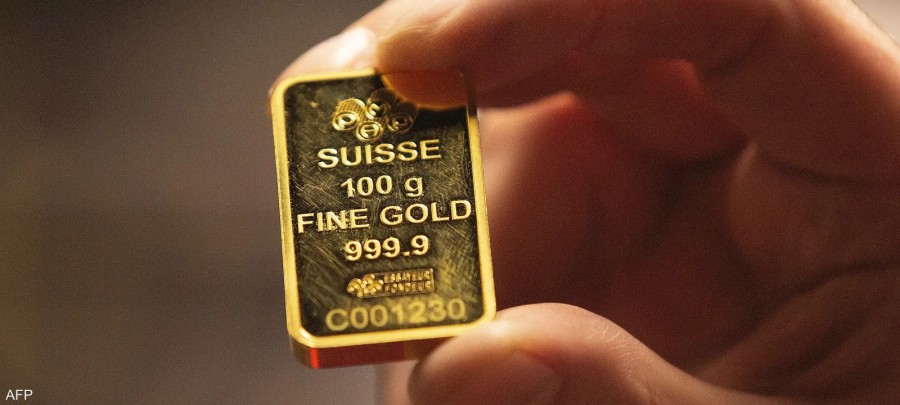


Gold prices rose during Wednesday's trading session amid thin market liquidity, recovering from a one-week low hit in the previous session, as investors awaited the release of the Federal Reserve's January meeting minutes for clues about the direction of interest rates.
As developments in the nuclear talks intersect with the Geneva negotiations to end the war in Ukraine, and markets await crucial data, the need for a comprehensive view that integrates geopolitical and economic factors becomes even more pressing. InvestingPro with WarrenAI offers you a complete analysis of the gold market. Subscribe now and take advantage of our limited-time 55% flash sale discount.
Watch for the Fed minutes and inflation data.
Ajay Kedia, director of Kedia Commodities in Mumbai, said prices found support above the $4,850 level, considering the current move a technical rebound after the previous session's decline, which came as a result of easing geopolitical tensions.
Kedia explained that investors are currently focused on the minutes of the Federal Reserve's January meeting, looking for clearer indications of the future path of monetary policy.
Market participants are also awaiting the US personal consumption expenditures report for December, due to be released on Friday, which is the Federal Reserve's preferred measure of inflation.
Current forecasts, according to the US interest rate tracking tool available on Investing Saudi Arabia, indicate that markets expect an interest rate cut during June, which usually supports gold if it happens, given that it is a non-yielding asset and benefits from a low interest rate environment.
Conflicting statements from Federal Reserve officials
Chicago Federal Reserve President Austan Goolsbee said the central bank could agree to several more interest rate cuts this year if inflation resumes its decline toward the target level of 2%.
In contrast, Federal Reserve Governor Michael Barr indicated that any further interest rate cut may not be imminent, given the continued risks surrounding the path of inflation in the United States.
This discrepancy in statements reflects a state of uncertainty within the markets regarding the timing and number of potential cuts, which explains gold's sensitivity to any new data or signals related to inflation or growth.
Geopolitical factors limit momentum
On the geopolitical front, Iran and the United States reached an understanding on the guiding principles for nuclear talks, but the Iranian foreign minister stressed that this does not mean that a final agreement is imminent.
Meanwhile, President Donald Trump is pressuring Kyiv to quickly reach an agreement, while Ukraine and Russia hold US-mediated peace talks in Geneva.
Matt Simpson, chief analyst at StoneX, said he expects gains to remain limited as buyers continue to take advantage of dips, predicting that gold will remain in a range between $4,700 and $5,100 in the near term.
Gold at settlement yesterday
Gold prices fell at the close of trading on Tuesday, pressured by a stronger dollar, signs of progress in nuclear talks between Iran and the United States, and the start of a new round of negotiations between Russia and Ukraine.
Gold futures for April delivery fell 2.78%, or $140.40, to $4,905.90 an ounce.
Gold now
Spot gold rose 1.2% to $4,934.74 an ounce, after falling more than 2% on Tuesday.
Gold futures for April delivery in the United States also rose by 1% to reach $4,954.
Strong movements in other metals
The spot price of silver rose 3.2% to $75.79 an ounce after having fallen by more than 5% in the previous session.
Platinum rose 2.2% to $2,051.55 an ounce, while palladium climbed 2.3% to $1,722.01.
These moves reflect that the recovery wave was not limited to gold alone, but included most precious metals, supported by short covering and cautious anticipation of upcoming US economic data.