

























Oil prices jumped sharply on Thursday after Iran intensified its attacks on oil facilities and transport across the Middle East, raising fears that the conflict could drag on and disrupt crude flows through the Strait of Hormuz.
Prices surged more than 9% as Brent crude hit $100 a barrel, before paring some of its gains, as traders remain unconvinced that drawing on government reserves can offset the massive supply shock caused by the war.
Brent crude futures rose $8.54, or 9.28%, to $100.52 a barrel at 7:00 AM Riyadh time, while West Texas Intermediate (WTI) crude futures climbed $7.22, or 8.28%, to $94.47. Prices have since pared some of their gains, with Brent currently trading at $98.30 a barrel and WTI at $93 a barrel at 9:42 AM Riyadh time.
Emergency measures to contain the supply crisis
The International Energy Agency announced on Wednesday that its 32 member countries will release about 400 million barrels from emergency reserves, in the largest coordinated release since the agency was founded following the oil export embargo in 1973.
The United States also announced that it would release 172 million barrels from its strategic petroleum reserve, with Energy Secretary Chris Wright indicating that shipments could begin next week and that the process could take about 120 days to complete.
Despite these steps, the oil market continued to largely ignore them as prices continued to rise, reflecting traders' doubts about the ability of these measures to close the supply gap if oil flows through the Strait of Hormuz remain disrupted.
Panic in the markets
Pavel Molchanov, chief investment strategist at Raymond James, said prices are still moving in a state of panic, noting that levels of fear and uncertainty are playing a major role in determining the direction of the market at present.
Saul Kavonic, an energy analyst at MST Markey, explained that the record drawdown from reserves will provide much-needed quantities for the market, but may only cover about a quarter of the supply gap estimated at around 20 million barrels per day as a result of the closure of the Strait of Hormuz.
He added that the IEA’s decision reflects the magnitude of the severe risks facing the market, and also indicates that the agency does not expect a near end to the conflict, which means that the quantities withdrawn now will need to be compensated for later, which may push prices up even after the war ends.
The importance of the Strait of Hormuz in energy trade
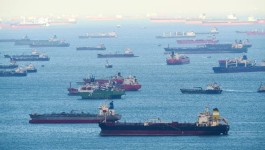
Approximately one-fifth of the world's oil supply passes through the Strait of Hormuz, as this vital waterway connects the Arabian Gulf with global markets.
The disruption of this route raises widespread concerns about the market's ability to meet global demand amid declining production and disruption to shipping.
This comes at a time when there are growing fears that continued conflict could lead to a real shortage of global supplies in the coming months.
Uncertainty surrounds the timing of the arrival of supplies.
The timing of when oil drawn from reserves will reach the market remains unclear, and this is one of the main reasons that keeps investors on edge.
Although the International Energy Agency’s announcement represents an unprecedented intervention, it did not provide sufficient details about the speed of releasing the reserves or the mechanisms for distributing them among countries.
Molchanov pointed out that the key question is how long it will take to actually pump 400 million barrels into the global market.
Logistical constraints may delay the impact.
Although this quantity is huge, the current crisis represents the biggest disruption to oil supplies since the 1970s, meaning the market needs large quantities of crude oil quickly.
Each member country of the International Energy Agency maintains its reserves separately, which can create technical and logistical challenges that delay the flow of oil to markets.
Molchanov estimated that it could take between 60 and 90 days for new supplies to arrive effectively, a longer timeframe than traders seeking a quick fix in the price crisis had hoped for.