



































Oil prices continued to decline amid signs of progress toward an agreement to end the trade war with Iran, including the United States issuing a waiver allowing some crude oil and fuel sales from Tehran.
Brent crude traded below $78 a barrel after falling 3.3% on Monday, while West Texas Intermediate crude settled near $74. The 60-day license, granted after productive talks in Switzerland, allows for the sale of some Iranian oil and petroleum products, a move Washington attributed to those talks, thus providing Tehran with a major economic lifeline.
US and Iranian officials indicated progress in the first round of talks toward a permanent agreement to end the conflict that began in late February, but some differences emerged. US Vice President J.D. Vance said Iran had agreed to allow nuclear inspectors into the country, a claim Tehran denied.
The exemption allows almost any entity to purchase and pay for Iranian oil, including American refineries, although some entities may be unwilling to take the risk.
Supplies from the Arabian Gulf have also recently seen a slight increase, with producers such as Kuwait and the UAE finding alternative solutions for exporting energy. Iran also shipped more than 30 million barrels last week.
Rebecca Babin, managing director and senior energy trader at CIBC Private Wealth, said: “There’s still a long way to go in the negotiations, and the market may be pricing in a surplus before it arrives, just as it priced in a deficit before the barrels actually disappeared. Crude oil has a tendency to overreact.”
Iran negotiations and the flow of the Strait of Hormuz
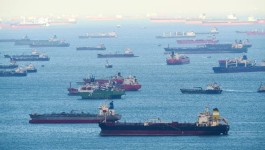
Protracted back-and-forth discussions are expected regarding Iran's nuclear capabilities as talks continue, along with efforts to establish a ceasefire in Lebanon between Israel and Hezbollah and to safely reopen the Strait of Hormuz. The near-total closure of the waterway has crippled energy supplies and upended markets.
Qatar is sending more empty liquefied natural gas (LNG) tankers into the Arabian Gulf via the Strait of Hormuz, adding to indications that flows through the vital waterway will gradually resume. Four tankers are currently transiting the strait without concealing their location, and more are en route.
Progress toward peace has narrowed price differentials, with the gap between the two nearest Brent crude contracts nearing parity. The benchmark for Dubai and Murban crudes in the Middle East has already shifted into a contango structure.
In the latest trading, Brent crude futures for August delivery fell 0.5% to $77.5 a barrel by 12:20 pm in Singapore, and West Texas Intermediate crude futures for August delivery fell 0.3% to $73.61 a barrel.