


































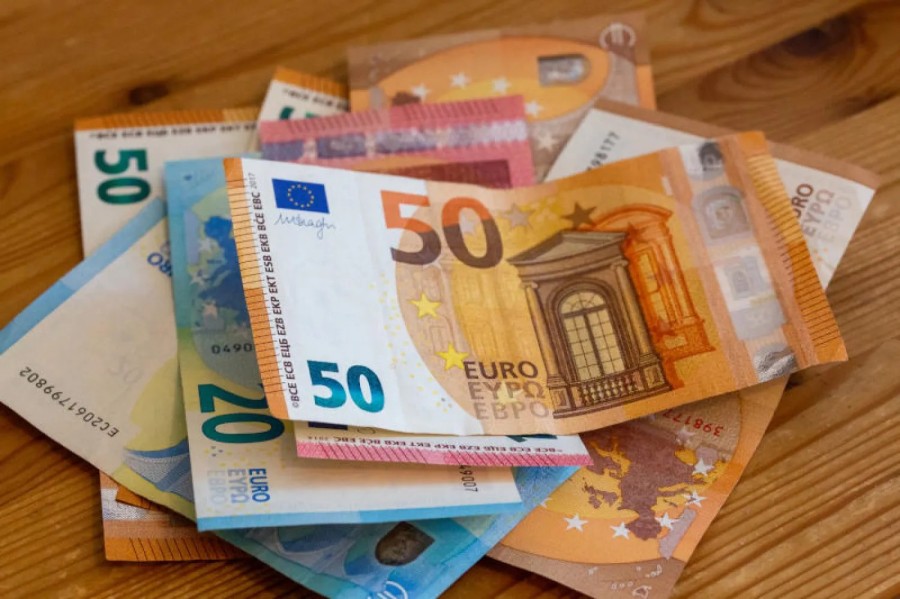


The euro fell in the European market on Wednesday against a basket of global currencies, deepening its losses for the second day in a row against the US dollar, recording its lowest level in a week, amid relative activity in buying of the US currency, especially after the minutes of the last meeting of the Federal Reserve, which showed a sharp division among officials about cutting interest rates in December.
Despite this decline, the euro is on track to record its biggest annual gain since 2017. These gains are based on a number of factors, most notably the improvement in economic growth indicators in the Old Continent, the tight monetary stance adopted by the European Central Bank during the second half of this year, in addition to the general weakness that dominated the performance of the US dollar in global markets.
Price overview
Euro exchange rate today: The euro fell against the dollar by 0.15% to ($1.1733), its lowest level since December 22, from today’s opening price of ($1.1748), and recorded a high of ($1.1749).
The euro ended Tuesday's trading down 0.2% against the dollar, its third loss in the last four days, due to the Federal Reserve minutes.
US dollar
The dollar index rose more than 0.1% on Wednesday, extending its gains for the second consecutive session and hitting a one-week high of 98.33 points, reflecting the continued rise in the US currency against a basket of global currencies.
According to the minutes of the Federal Reserve’s most recent meeting, held on December 9-10, the US central bank agreed to cut interest rates after an in-depth discussion about the risks facing the US economy.
The minutes revealed that the decision to cut interest rates by 25 basis points to a range of 3.75%, the lowest level since 2022, faced significant opposition, with 9 members voting in favor and 3 against, the largest number of defections since 2019.
The minutes indicated the US Federal Reserve's inclination towards caution in upcoming meetings, with some participants suggesting that holding interest rates steady for a period of time after the December cut would be the most appropriate option.
The Federal Open Market Committee projected only one more interest rate cut throughout 2026, indicating a more cautious and hawkish approach compared to previous forecasts.
According to the CME Group's FedWatch tool: the probability of US interest rates remaining unchanged at the January 2026 meeting is currently stable at 84%, and the probability of interest rates being cut by about 25 basis points is stable at 16%.
European interest rate
The money market pricing for the likelihood of the European Central Bank cutting European interest rates by about 25 basis points in February 2026 is currently stable at less than 10%.
In order to reprice the above probabilities, investors are awaiting further economic data from the Eurozone on inflation, unemployment and wage levels.
Interest rate gap
Following the Federal Reserve’s recent decision, the interest rate gap between Europe and the United States has narrowed to 160 basis points in favor of the US interest rate, the lowest gap since May 2022, which is in favor of a higher exchange rate for the euro against the US dollar.
Annual transactions
Over the course of trading in 2025, which officially ends with today's price settlement, the single European currency, the Euro, is currently up more than 13% against the US Dollar and is on track to achieve its second annual gain in the last three years, and its largest annual gain since 2017.
Reasons for this historical superiority
The resilience of the European economy : The Eurozone showed better-than-expected economic growth in 2025, particularly with the recovery of industrial and commercial activities in Germany, the Eurozone's largest economy.
European Central Bank policy : Contrary to expectations, the European Central Bank maintained a relatively hawkish stance toward the Federal Reserve, particularly during the second half of this year, thus preserving the appeal of the euro as a high-yielding and stable currency.
The weakness of the US dollar is due to the Federal Reserve's interest rate cuts, rising concerns about financial stability in the United States, Donald Trump's volatile trade policies, and concerns about the Federal Reserve's independence under the Trump administration.