



































Oil pared its biggest jump in four years, as traders assessed the consequences of a de facto closure of the Strait of Hormuz as a result of the war being waged by the United States and Israel against Iran.
Brent crude, a global benchmark for oil prices, rose by more than 6% to around $78 a barrel, after having earlier jumped by about 13% to its highest level since January 2025.
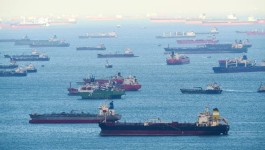
Oil tanker traffic through the strait, a chokepoint off the coast of Iran that handles a fifth of the world's oil and large quantities of gas, has largely come to a standstill, with ship owners and traders temporarily halting operations as the conflict intensifies.
Impact of the conflict on markets
While Iranian authorities said on Sunday that the main waterway remained open, they also claimed to have attacked three oil tankers. For his part, President Donald Trump said that US forces had destroyed and sunk nine Iranian naval vessels, and that combat operations would continue until all objectives were achieved.
In response to the escalating conflict, the OPEC+ alliance agreed at a pre-arranged meeting over the weekend to increase supply quotas next month by 206,000 barrels per day. The alliance, which includes Iran, Saudi Arabia, and Russia, had been expected to resume modest increases before the outbreak of hostilities on Saturday.
The conflict represents a dangerous new phase for the global oil market. The United States and Israel launched missiles at targets across Iran on Saturday, killing Iranian Supreme Leader Ali Khamenei, while urging the Iranian people to overthrow the regime. Tehran responded with a wave of strikes against Israel, as well as US bases and other targets in countries including Saudi Arabia, Qatar, the United Arab Emirates, Kuwait, and Bahrain.
Harris Khurshid, chief investment officer at Carobar Capital in Chicago, said: “If tanker traffic resumes quickly, or there is a credible de-escalation, or behind-the-scenes diplomatic talks take place, we will see a pullback. Otherwise, we are likely to settle at higher levels.”
Rising prices may make it more difficult to combat inflation.
Crude oil prices have risen this year, posting consecutive monthly gains, driven by ongoing geopolitical tensions and a series of domestic supply disruptions. These gains have occurred despite expectations of a significant oil surplus following increased production from OPEC+ and non-OPEC producers.
If energy costs continue to rise, they threaten to increase inflationary pressures worldwide. This could complicate the task for central banks, including the US Federal Reserve, in managing the pace of price increases while simultaneously supporting growth and employment.
Analysts at Citigroup, including Max Leighton, wrote in a note before trading began on Monday: “We see Brent crude trading in the $80-$90 per barrel range in our baseline scenario, at least through the next week.”
They added: Our basic view is that the Iranian leadership will change, or the regime will change sufficiently to stop the war within a week or two, or the United States will decide to de-escalate after witnessing a change in leadership and a rollback of the nuclear and missile programs within the same timeframe.
Morgan Stanley raised its forecast for Brent crude in the second quarter to $80 a barrel from $62.50.
Oil could exceed $100 a barrel
Iran pumps about 3.3 million barrels per day, or 3% of global production, but the country wields greater influence over energy supplies due to its strategic location on the Strait of Hormuz. Oil from the Persian Gulf must pass through this waterway to reach major markets such as China, India, and Japan.
In an interview with The New York Times, Trump said the United States intends to continue its offensive against Iran for four to five weeks. He also said he is open to lifting sanctions if the new leadership proves itself to be a pragmatic partner.
Analysts at Goldman Sachs Group, including Dan Strovin, wrote in a note: The movement of oil tankers appears to have been significantly disrupted as many shipping companies, oil producers, and insurers have shifted to a cautious wait-and-see approach.
They added: To the best of our knowledge, there is no confirmed damage to oil production or oil export infrastructure.
If tanker flows through the Strait of Hormuz are not resumed quickly, oil prices could exceed $100 a barrel, according to Wood Mackenzie. It stated that even with OPEC+ increasing production in April, the alliance's additional volumes and spare capacity will be unavailable if the waterway remains closed.
Rising prices put pressure on Trump
Prior to the war with Iran, President Trump had adopted an increasingly aggressive foreign policy. In late January, U.S. forces invaded Venezuela and arrested former President Nicolás Maduro, after which the administration seized control of the country's oil industry.
Higher crude oil prices are likely to translate over time into higher product prices, including retail gasoline, an indicator closely watched in U.S. policy.
As the conflict in the Middle East unfolds, one of Trump's options may be to release crude oil from the U.S. Strategic Petroleum Reserve, an emergency stockpile stored in massive underground vaults. The reserve held approximately 415 million barrels as of February 20, according to government data.
The International Energy Agency (IEA), based in Paris and advising major economies, said markets have been well supplied so far, according to Executive Director Fatih Birol. He added in a social media post that the group is in contact with producers in the region, as well as with member governments.
In the latest trading, Brent crude futures for May settlement rose 6.4% to $77.55 a barrel at 1:31 p.m. in Singapore, after rising as high as $82.37 a barrel earlier, while West Texas Intermediate crude futures for April delivery rose 6.1% to $71.11 a barrel.