























Oil prices rose to their highest level in three weeks, surpassing $110 a barrel in London, as traders awaited the US response to an Iranian proposal to end the war and reopen the vital Strait of Hormuz.
Brent crude climbed above $111 a barrel, bringing its gains this week to around 10%, while West Texas Intermediate crude was above $98.
US President Donald Trump held a meeting to discuss the proposal, but he stuck to red lines in any agreement to end the war, including preventing Tehran from acquiring a nuclear weapon.
The continued blockade is putting pressure on supplies and prices.
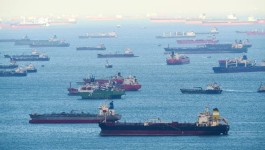
Although the ceasefire has largely held since early April, the blockade of the Strait of Hormuz by Iran and the United States has reduced daily traffic through the waterway to almost zero.
The shutdown has choked off flows of crude oil, natural gas and petroleum products, driving up energy prices and raising fears of an inflation crisis.
Florence Schmidt, energy strategist at Rabobank, said: “The latest Iranian proposal appears unlikely to lead to a result, as the United States is unlikely to accept it. Oil markets are currently facing the reality that there is no quick fix to the embargo.” She added that much of the risk aversion that has driven markets in recent weeks is beginning to subside, giving way to a more pessimistic outlook on risk appetite.
Iranian proposals and American skepticism
Iranian media reported on Sunday that Foreign Minister Abbas Araqchi will tell Pakistan, which is mediating peace talks, that the conflict could end if the United States lifts its naval blockade, agrees to a new legal framework for traffic through the Strait, and provides assurances that no future military action will be taken against Iran.
The Wall Street Journal, citing unnamed US officials, reported that Trump and his national security team are skeptical of the Iranian proposal, but will continue to negotiate, and that the White House is likely to present its response and counter-proposals in the coming days.
The report added that the US president indicated that Tehran was unwilling to meet his main demands to end uranium enrichment and pledge not to manufacture a nuclear weapon.
For his part, Secretary of State Marco Rubio said that Iran still wants to maintain control of the Strait of Hormuz, which he deemed unacceptable to the United States, in an interview with Fox News that aired Monday. Before the war, roughly one-fifth of the world's oil and liquefied natural gas supplies passed through this narrow waterway.
Shipping disruptions and supply shortages
Data showed that two oil tankers linked to Iran, which were intercepted by US forces near Sri Lanka last week as part of the blockade, had halted their westward course in the Indian Ocean and turned back.
The US blockade on shipping to and from Iranian ports began on April 13 and has diverted dozens of ships.
Iran also suffers from a severe shortage of storage space for its crude oil, increasing the likelihood that it will have to cut production even further, according to data analytics firm Kpler.
US Treasury Secretary Scott Bisent said in a social media post that Iran's oil sector has begun reducing production as a result of the sanctions.
Linh Tran, a market analyst at XS.com in Ho Chi Minh City, Vietnam, believes that futures markets are pricing in a prolonged period of supply cuts and that geopolitical risks remain high. She added, however, that any tangible progress in negotiations could trigger a sharp correction.
In the latest trading, Brent crude futures for June delivery rose 2.7% to $111.10 a barrel at 8:53 a.m. in London, while the more actively traded July contract climbed by the same percentage to $104.40 a barrel. West Texas Intermediate crude futures for June delivery rose $2.50 to trade at $98.75 a barrel.