

































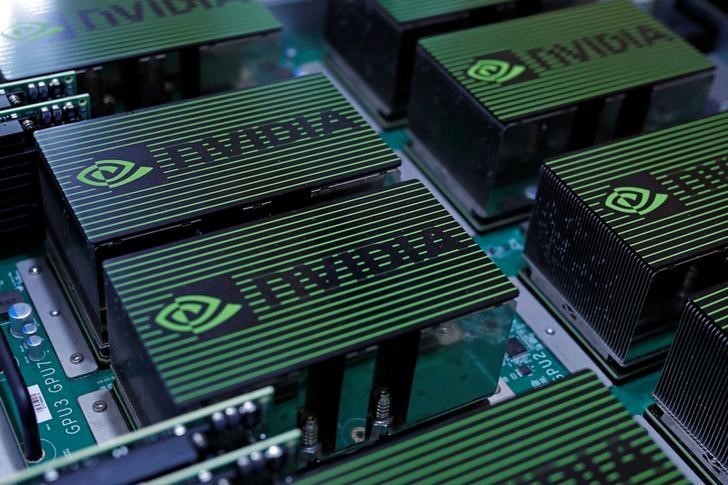


Nvidia has informed its customers in China that it is considering adding new production capacity for its advanced H200 AI chips, after orders exceeded its current production level, according to two sources familiar with the matter who spoke to Reuters.
This move comes after US President Donald Trump announced on Tuesday that the US government would allow Nvidia to export its H200 processors, the company's second-fastest AI chips, to China, subject to a 25% tariff on these sales.
One of the sources said that demand for these chips from Chinese companies is so strong that it is pushing Nvidia to add new production capacities.
In a statement to Reuters following the publication of the report, an Nvidia spokesperson said the company manages its supply chain in a way that ensures the sale of licensed H200 processors to authorized customers in China does not affect its ability to meet customer demand in the United States.
Major Chinese companies, including Alibaba and ByteDance, have already contacted Nvidia this week about purchasing H200 chips and have expressed interest in placing large orders.
However, uncertainty remains, as the Chinese government has not yet given the green light for any purchases of H200 chips. One of the sources, along with a third source, said that Chinese officials held emergency meetings on Wednesday to discuss the matter and will decide whether to allow the chips to be shipped to China.
Reuters reported on Wednesday that very limited quantities of H200 chips are currently being produced, as the US AI chip giant focuses on manufacturing its more advanced Blackwell lines and the anticipated Rubin series.
As China seeks to bolster its domestic artificial intelligence industry, sources said that the supply of H200 chips has been a major concern for Chinese customers, prompting them to contact Nvidia for further clarification.
One of the initial sources added that Nvidia, in the briefing it provided to customers, offered guidance on current supply levels, without disclosing a specific number.
H200 chips
The H200 chips entered mass deployment last year and are the fastest AI chips in Nvidia's previous Hopper generation. These chips are manufactured by TSMC using the Taiwanese company's 4nm manufacturing technology.
TSMC declined to comment on allocating production capacity to specific customers, referring instead to statements made by Chairman and CEO C.C. Wei regarding the company's approach to production capacity planning in light of the strong surge in demand for AI chips.
The strong demand from Chinese companies for H200 chips is due to them being by a significant margin the most powerful chips they can currently access.
These chips are about six times more powerful than the H20 chip, a lower-powered version from Nvidia designed specifically for the Chinese market and launched in late 2023.
Trump's decision regarding the H200 chips comes at a time when China is striving to advance and develop its domestic artificial intelligence chip industry. With local companies yet to produce chips comparable to the H200, concerns have arisen that allowing these chips into China could hinder the growth of the domestic industry.
Nouri Chiu, investment manager at White Oak Capital Partners, said the computing performance of the H200 chips is roughly two to three times that of the most advanced domestic accelerators.
Chiu added: “I’ve already noticed that many cloud computing service providers and large companies are placing large orders intensively and are putting pressure on the government to ease restrictions under specific conditions,” noting that Chinese demand for artificial intelligence exceeds domestic production capacity.
During the emergency meetings, a proposal was put forward to link every purchase of H200 chips to the purchase of a certain percentage of locally made chips, according to one of the first sources, along with a third source.
As for Nvidia, adding new production capacities is a challenge at this stage, not only because of its transition to the “Rubin” generation, but also because of competition from other companies, including Alphabet’s Google, for TSMC’s limited advanced chip manufacturing capacities.