








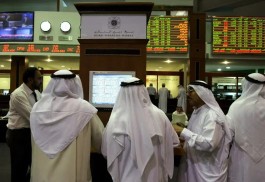




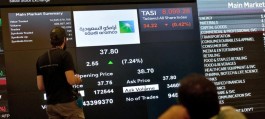


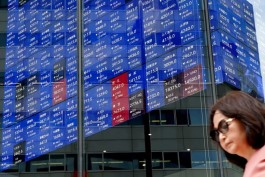


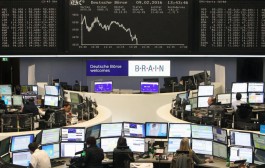











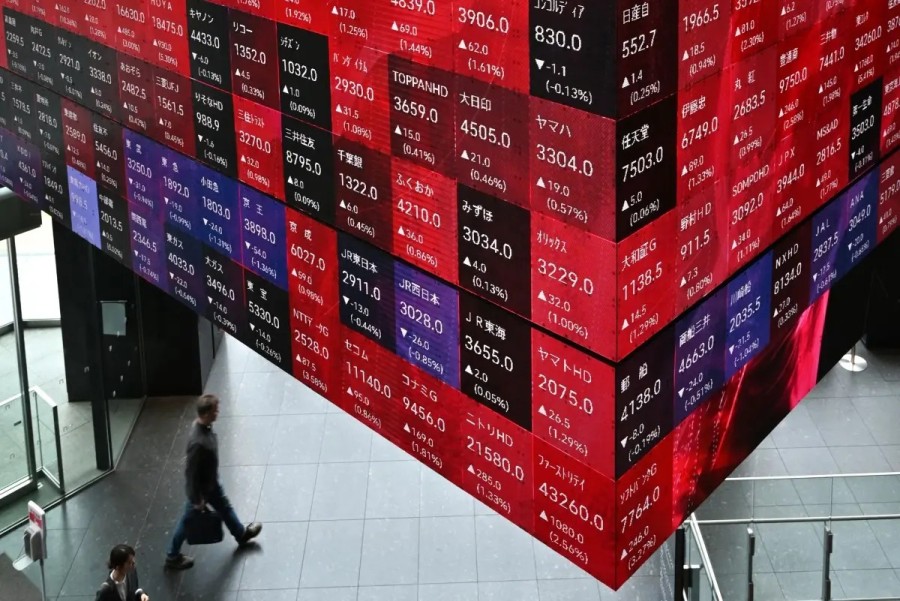


Stocks in Asia rose slightly on Monday, as traders prepared to deal with a series of central bank decisions this week, along with assessing the broader outlook for high-risk assets as the new year approaches.
The MSCI Asia Pacific Index rose 0.2% after two consecutive weeks of gains, in line with rising US stock index futures in Asian trading.
The Nikkei 225 index fell 0.2%. The Japanese government confirmed on Monday, in a revised report, that Japan's economy contracted in the three months to September, while signs emerged over the weekend of deteriorating relations between Tokyo and Beijing.
With markets already pricing in a 25-basis-point interest rate cut from the Federal Reserve this week, markets have moved within narrow ranges due to the lack of new catalysts.
Global stock markets are still hovering near their highest level since October, amid investor caution about the sustainability of the AI-driven rally this year.
Chris Weston, head of research at Pepperstone Group, wrote in a note: The Fed meeting will be the key event on the risks front. A 25-basis-point cut is fully priced in and seen as a foregone conclusion, but the real debate is about the shape of the aggressive cut and whether the statement and Jerome Powell's press conference will align with this expected outcome.
Tensions between China and Japan
Central banks stretching from Australia to Brazil and the Philippines will announce interest rate decisions this week, as renewed inflationary pressures prompt a reassessment of monetary policy prospects for 2026.
Relations between China and Japan, and assets in both countries, have been a focus in Asia after a Chinese fighter jet pointed its engagement radar at Japanese fighters for the first time over the weekend.
Japan's gross domestic product fell 2.3% year-on-year in the third quarter, as revised figures showed weak business spending and residential investment, compared with the initial reading of a 1.8% decline. This was the first contraction in six quarters.
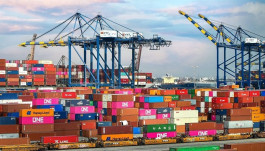
Traders will also be watching China's November trade data to assess the health of the economy and the impact of limited US tariff easing. US Trade Representative Jameson Greer said over the weekend that China has so far adhered to the terms of the bilateral trade agreements.
Meanwhile, French President Emmanuel Macron warned that the European Union may be forced to take strong action against China, including possible tariffs, if Beijing fails to address its growing trade imbalance with the bloc.
Dollar fluctuations and rise in metals
The dollar index edged lower on Monday after ending last week with its fourth decline in five weeks. In the metals markets, silver fluctuated near a record high and gold rose after the People's Bank of China added to its reserves for the thirteenth consecutive month in November.
Oil prices were steady as traders monitored India's purchases of Russian crude and Ukrainian attacks on Russia's energy infrastructure.
The S&P 500 index rose 0.2% on Friday, nearing a record high, after an older reading of the Federal Reserve's preferred inflation gauge came in line with expectations.
Treasury yields end worst week since April
Treasury bonds fell, pushing the 10-year yield up four basis points to 4.14%, ending its worst week since April, after conflicting economic data sparked fresh uncertainty about the extent of the Fed's interest rate cut next year.
Tony Sycamore, an analyst at IG Markets in Sydney, wrote in a note: “US bond yields could continue to rise, perhaps to around 4.5%, supported by an anticipated fiscal boost from spending projects previously approved by President Donald Trump, strong growth, and the broader inflationary momentum sweeping through long-term bond yields globally.”
He added: We believe this will most likely be the story of 2026, but a rise of this magnitude could affect stocks if it happens quickly.
Decisions regarding interest rates
Auctions for 3-, 10-, and 30-year bonds are scheduled to begin this week on Monday, a day earlier than usual, to avoid coinciding with the Federal Reserve's announcements on December 10. Australia will also reopen a bond issue maturing in 2054, coinciding with the 10-year yield reaching its highest level since November 2023.
The US continues to process its backlog of data with the release of delayed job openings reports, along with weekly unemployment claims and the labor cost index. Regarding interest rate decisions, the Bank of Canada, the Swiss National Bank, and the Reserve Bank of Australia are all expected to leave rates unchanged this week.
Barclays experts, including Andrea Kegel, wrote in a note to clients: “Although the Fed will most likely cut interest rates on Wednesday, the path to interest rates for 2026 is more uncertain, as members of the Federal Open Market Committee weigh lingering price pressures from tariffs, a slowing labor market, and the likely economic recovery over the coming months.”
They added: We expect 2026 to be a year of keeping interest rates unchanged, although the market may try to price in increases if inflation momentum continues.
On the other hand, veteran Wall Street researcher Ed Yardeni recommends reducing the relative weight of the Big Seven technology stocks (Meta, Microsoft, Apple, Amazon, Nvidia, Alphabet, Tesla) against the rest of the S&P 500 components, anticipating a shift in earnings growth in the coming period.