





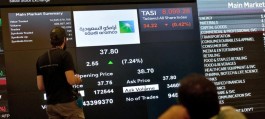


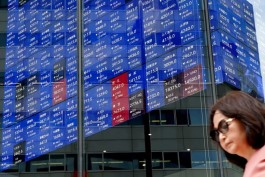
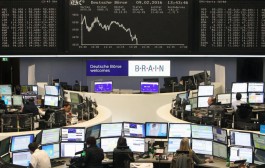









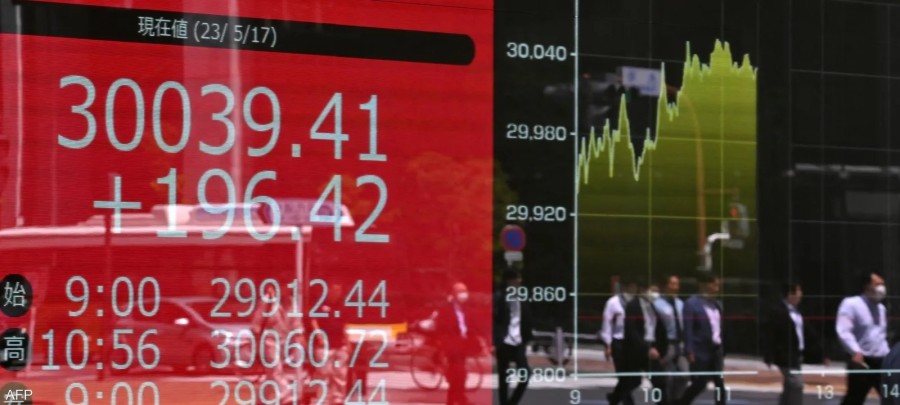


Asian stocks rose and oil gains faded, as investors cautiously returned to equity markets, supported by signs that the conflict between Iran and the United States might be contained.
Standard stock indices in both Japan and South Korea rose by more than 1%, contributing to a 0.5% increase in the MSCI Asia Pacific index.
Two stocks rose for every one that fell within the index, with technology stocks outperforming. S&P 500 futures also erased earlier losses to rise 0.3%.
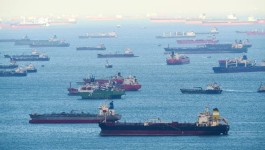
A report by Axios indicating that the United States, Iran, and a group of regional mediators are discussing the terms of a potential 45-day truce that could lead to a permanent end to the war contributed to the improved sentiment. Other reports over the weekend regarding oil tanker movements in the Strait of Hormuz also supported this trend.
Markets are betting on avoiding the worst
Tarek Hourshani, head of sales trading and principal brokerage at Maybank Securities, said that Asian markets in particular tend to react quickly to any indications that the worst-case scenarios, such as a complete disruption of oil flows, can be avoided.
He added: This is why we are seeing a modest recovery, especially in sectors such as semiconductors and economic cycles.
Traders are seizing on any headlines that could affect sentiment, after the Iran war weakened economic prospects and raised inflation fears, confusing expectations about an interest rate cut by the Federal Reserve.
The focus remains on energy prices and the closure of the Strait of Hormuz, the vital waterway for oil flows from the Middle East.
Difficulty in predicting for investors
Homin Lee, a strategist at Lombard Odier in Singapore, said: The forecasting game remains extremely complicated for investors.
He added: Investors will be directly focused on military movements on both sides of the Arabian Gulf, and whether the passage of ships through the Strait of Hormuz can improve despite these attacks.
Traders will be watching for the impact of rising oil prices when monthly US inflation data is released on Friday. The nearly $1 increase in the price of a gallon of gasoline likely pushed the Consumer Price Index up 1% in March, the largest increase since the post-pandemic inflation wave of 2012, according to an economic survey conducted before the report's release.
Gold and metals declined
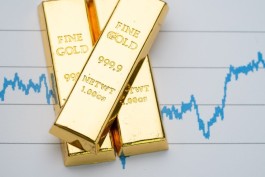
In other markets, gold fell 0.5% to around $4,650 an ounce, while silver dropped 0.8% to around $72 an ounce.
The precious metal has fallen by more than 12% since the conflict began in late February, as rising energy prices have fueled inflation fears and reduced the likelihood of interest rate cuts, which usually benefit non-yielding metals.
Financial markets in a number of Asian economies, including China and Hong Kong, were closed on Monday.
Attacks affecting the energy sector
Early Sunday, US President Donald Trump renewed his threats to attack Iranian infrastructure if the vital energy shipping lane through the Strait of Hormuz remains closed. He followed this with another post saying: Tuesday, 8:00 PM EST! Without providing any further details.
Meanwhile, continued attacks by Iran have damaged the Kuwait Petroleum Corporation headquarters and forced the closure of a petrochemical plant in the UAE. The semi-official Fars News Agency reported that 15 ships transited the Strait of Hormuz with Iran's approval, based on the latest shipping data.
Trump had previously softened his threats of escalation, including two weeks before the markets reopened for the new week. He also said he planned to hold a press conference at 1 p.m. New York time on Monday.
Charu Chanana, strategist at Saxo Capital Markets in Singapore, said: Markets may be ahead of diplomacy once again.
She added: Trump's language over the weekend suggested that diplomacy was losing ground, so there is still a real risk that markets are pricing in hopes of de-escalation at a faster pace than political reality can deliver.