

















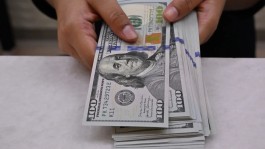


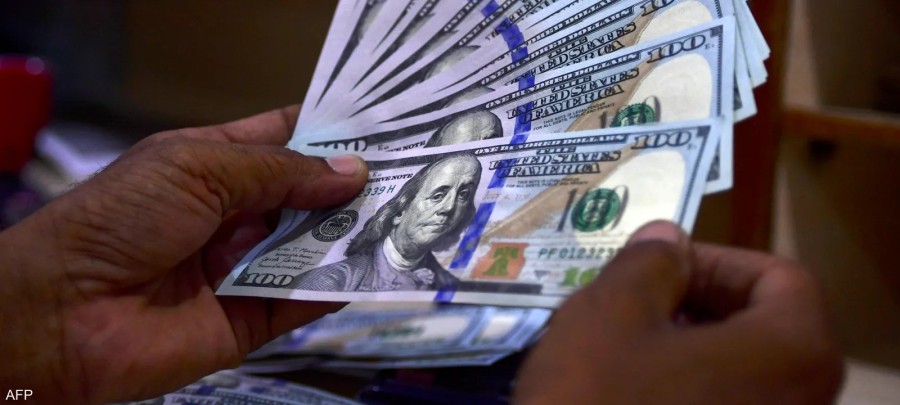
The US dollar was steady during Wednesday's trading, as markets remained on alert for the latest developments between the United States and Iran, as well as awaiting anticipated US inflation data that could provide important indications regarding the Federal Reserve's interest rate path.
US forces launched strikes on Iranian targets after US President Donald Trump vowed on Tuesday to retaliate for the downing of a US Apache attack helicopter, in a new escalation that threatens to unravel the fragile ceasefire between Washington and Tehran.
In response, the Iranian Revolutionary Guard announced that it had carried out missile and drone attacks on US military bases in Jordan, Kuwait and Bahrain, in retaliation for US strikes targeting Iranian sites near the Strait of Hormuz.
The US dollar index, which measures the performance of the US currency against a basket of major currencies including the yen and the euro, recorded a slight decline to 99.88 points.
The euro rose by about 0.1% to $1.1553, and the British pound climbed by roughly the same percentage to $1.3386.
Dominic Banning, head of G10 currency strategy at Nomura, said that markets still see the prospects of a deal or settlement between the United States and Iran as more likely than a full-blown escalation, despite renewed tensions in the short term.
Markets are monitoring the path of US interest rates amid escalating geopolitical risks.
He added that investors are also focusing on US economic data and interest rate forecasts, especially with Kevin Warsh taking over as chairman of the Federal Reserve.
Banning noted that markets may need to move out of their current state of anticipation at some point, explaining that most investors tend to believe that the dollar may continue to gain some strength given the continued solidity of US economic data.
US inflation data and the Japanese yen are in focus.
Investors are awaiting the release of the US Consumer Price Index (CPI) data for May later on Wednesday, which is seen as a crucial factor in assessing the likelihood of the Federal Reserve raising interest rates again this year, following last week's strong US jobs data.
Shu Suzuki, a market analyst at Matsui Securities, said that accelerating US inflation would bolster expectations of interest rate hikes, which would support the US dollar.
Japanese Yen
In Asia, the Japanese yen remained the focus of market attention, with markets almost fully pricing in the possibility that the Bank of Japan will raise interest rates at its meeting scheduled for June 16. This means that the decision alone may not be enough to reverse the yen's weakness unless it is accompanied by a hawkish speech from the bank's governor, Kazuo Ueda.
Tony Sycamore, a market analyst at IG, said that markets need clear signals from Ueda about the possibility of bringing forward the next interest rate hike from December to September, with the potential for a third increase before the end of the year, in order for the yen to recover significantly.
He added that the Japanese Ministry of Finance may have to intervene again in the foreign exchange market if the currency continues to weaken.
The Japanese yen was almost unchanged at 160.36 yen to the dollar, continuing to move near the 160 level, which investors consider a red line that could prompt official intervention by Japanese authorities.
A Reuters poll of economists showed that the Bank of Japan will raise its key interest rate this month and again in the fourth quarter, pushing borrowing costs up to 1.25% by the end of the year, as the central bank grows increasingly concerned about the risks of inflation.
Data released on Wednesday also showed that Japan's wholesale price inflation accelerated to a three-year high of 6.3% in May compared to the same period last year, driven by expanding price pressures resulting from the war in the Middle East.

UAE's Mubadala leads a $400 million financing round for German insurance company Wefox
Wefox, an insurance technology company founded by former emp.. Read more

Saudi Arabian Centers distributes dividends to shareholders for the second half of 2022 with a total of 356.25 million riyals
Arabian Centers Company has approved the distribution of cas.. Read more

The largest sovereign funds: "Abu Dhabi Investment Authority" advances to third place globally, with assets of $708.8 billion
The Abu Dhabi Investment Authority has advanced to the third.. Read more
Accumulated losses place Emirati companies on the "second category" screen, pending anonymity
Special Report - (Namazone): A group of companies listed.. Read more

Details 142 Saudi initiative to face the consequences of "Corona" B214 billion riyals
Special Report (Nmazzon): The government announced that.. Read more

Will gold remain a safe haven asset?
Gold has long been a source of controversy and contention am.. Read more
Global trade is expected to decline in the coming months
The economics department of Qatar National Bank (QNB) said t.. Read more

Analysis .. How will major central banks respond to the increasing cases of financial instability?
The global macroeconomic environment is experiencing some of.. Read more

The euro is below the dollar .. the lowest level in 20 years
For the first time in 20 years, the euro fell below $1 on Tu.. Read more

"OPEC"...The pressures of supply shortage will continue next year
OPEC expected global demand for oil to increase next year, b.. Read more
The dollar is moving cautiously amid escalating US-Iranian tensions and anticipation of inflation data.

NamaaZone " The Power of Knowledge"


Analysis Service |
Its a free service for technical consultation provided by NamaaZone to the website visitors. |
Open account Request |
NamaaZone provides a range of integrated trading solutions in local and global financial markets |