
































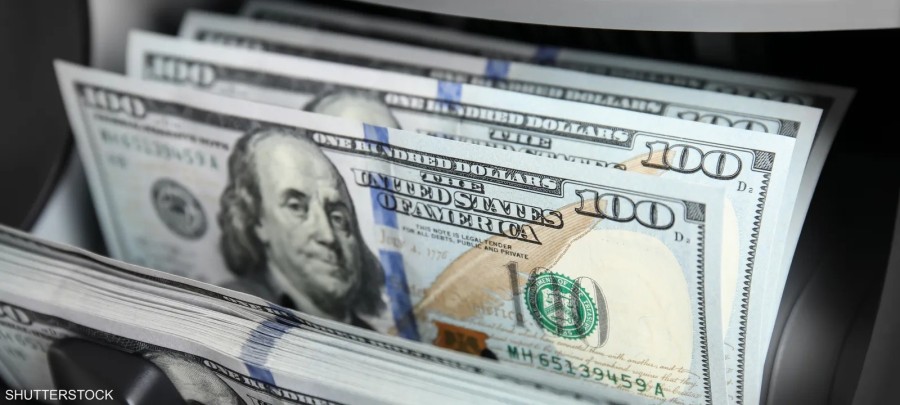


The US dollar continued its strong rally on Thursday, breaking through key technical resistance levels and heading for its biggest monthly gain in nearly a year, as investors bet on the strength of the US economy and continued high interest rates, while markets await key US inflation data.
During the current week, the dollar succeeded in pushing the euro below the $1.14 level, after the US currency touched its highest level in 13 months at $1.1325 against the euro on Wednesday, before settling during Asian trading near the $1.1370 level.
The dollar also rose to 161.73 yen, nearing its highest level in more than four decades against the Japanese currency, which continues to come under strong pressure.
This sharp rise in the dollar led to gold falling below $4,000 an ounce for the first time in more than 7 months, and also pushed Bitcoin down below $60,000 for the first time since 2024.
Interest rate bets support the US dollar
The dollar index, which measures the performance of the US currency against a basket of six major currencies, hit a 13-month high of 101.8 points on Wednesday, before settling near 101.5 points during Thursday's trading.
OCBC currency strategist Mo Seong Sim said the Federal Reserve continues to send hawkish signals to the markets, which has led investors to raise their expectations for an interest rate hike before the end of the year.
He added that traders who had expected interest rates to be cut before the outbreak of war between the United States, Israel and Iran now expect the first interest rate hike to take place as early as next October.
These changes reflect a major shift in US monetary policy expectations compared to what they were a few months ago.
The strength of the US economy reinforces the dollar's power.
Since the beginning of May, yields on two-year US Treasury bonds, which reflect expectations of short-term interest rates, have risen by 27 basis points to 4.15%.
In contrast, yields on two-year German bonds fell by 7 basis points to 2.56%, widening the yield gap in favor of the United States.
The gap between US and German 10-year bond yields also widened by 20 basis points during the same period, exceeding 150 basis points.
Steve Englander, head of global G10 currency research at Standard Chartered in New York, said that interest rate and dollar movements reflect expectations that the US economy will outperform rival economies.
Englander explained that strong productivity growth, partly supported by increased investment in artificial intelligence technologies, is expected to support the growth of US corporate profits.
He added that this would attract more capital flows to the United States, which would give the dollar additional support in the coming period.
Meanwhile, the dollar hit a seven-month high against the British pound at $1.314 on Wednesday and an 11-month high against the Swiss franc at 0.8139 francs, before trading near these levels during Thursday's trading.
advertisement
Pressure also continued on currencies linked to high-risk assets, despite the relative stability of stock markets.
Australian and New Zealand dollars under pressure
The Australian dollar has fallen 1.8% since the start of the week to settle near the US$0.69 level, although May's employment data came in line with expectations, the downward revision of April's data limited its positive impact.
The New Zealand dollar, which lost 1.7% of its value this week, settled at US$0.5646, near its seven-month low of US$0.5631 recorded on Wednesday.
This performance reflects investors' continued aversion to risk-related currencies amid a strong US dollar and rising returns.
The movements of these currencies remain largely dependent on expectations of US monetary policy and investors' appetite for risky assets.
Markets await inflation data and warnings of Japanese intervention.
Investors are awaiting the final reading of the US first-quarter GDP later on Thursday, along with weekly jobless claims data, as they also look forward to the release of personal consumption expenditures data, the Federal Reserve's preferred measure of inflation, for new indicators that may help predict the course of US monetary policy in the coming months.
Although forecasts indicate a rise in the personal consumption expenditures index reading, the return of oil prices to pre-war levels has strengthened bets on a slowdown in inflation in the coming period, and long-term US bonds saw a rise during Wednesday's trading, which led to a decrease in their yields.
Brent Donnelly, president of Spectra Markets, said that a continued rise in the dollar requires a widening gap between US interest rates and those in other economies, but noted that strong corporate demand for dollars to settle financial obligations will continue to support the US currency in the short term.
He added that this demand, coupled with increased speculative positions and the dollar's breakout above key technical levels, boosted the upward momentum of the US currency. However, he predicted that these factors would gradually lose their influence, potentially leading to a slowdown in the dollar's appreciation in the coming period.
In Japan, traders believe that if the dollar continues to rise to or exceeds 162 yen, it could prompt Japanese authorities to intervene directly in the foreign exchange market to support the local currency.
Hirofumi Suzuki, currency strategist at SMBC in Tokyo, said that the accumulation of short positions on the yen means that any official intervention by Japanese authorities could have significant effects on the markets and lead to sharp movements in the exchange rate.