
















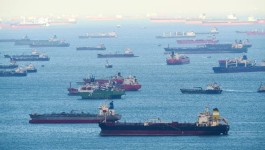












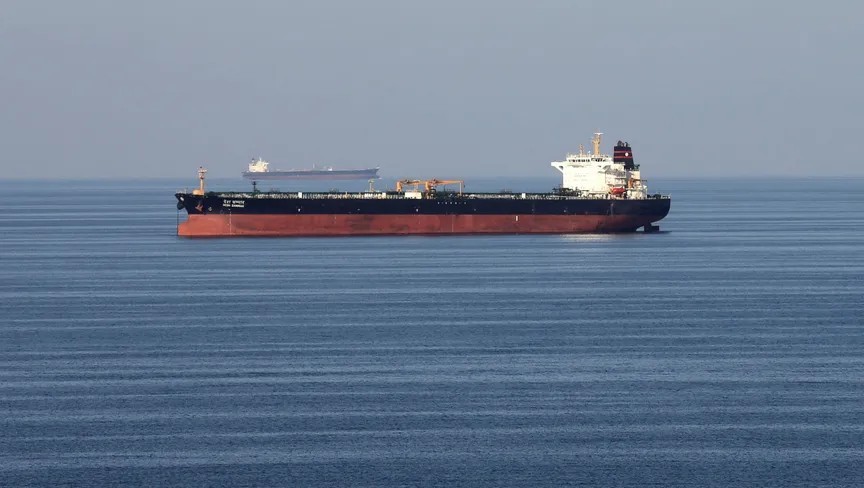


Oil tankers passing through the Strait of Hormuz, with signals turned off, are helping to keep oil flows this month at stronger levels than earlier in the Middle East conflict, as shipping companies await the signing of a peace agreement between the United States and Iran this week.
At least four tankers carrying non-Iranian crude oil left the Persian Gulf between Sunday and Monday after disabling their tracking devices. Bloomberg calculations, based on data from Kpler and Vortexa, indicate that the seven-day average of expected outgoing oil flows has exceeded 2 million barrels per day so far this month.
Iran's exports accelerate
Iran's own exports also appeared to be accelerating ahead of the anticipated agreement, which is expected to reopen Iranian oil trade with the lifting of US sanctions. Three tankers, fully loaded with approximately 5 million barrels of crude, appeared to have crossed the US maritime barrier and were en route to Asia.
Because ships can move without transmitting their location until they are far enough away from the Strait of Hormuz, automatic positioning signals have been collected over a wide area encompassing the Gulf of Oman, the Arabian Sea and the Red Sea to monitor ships that may have left or entered the Arabian Gulf.
When identifying potential transits, the signal history is examined to determine whether the movement appears genuine or is the result of spoofing - since electronic interference can alter the vessel's apparent position.
Some transits may go undetected if the ships' tracking devices are not switched back on. Oil tankers linked to Iran often sail from the Persian Gulf without transmitting signals until they reach the Strait of Malacca, approximately ten days after passing Fujairah in the UAE. Other vessels may employ similar tactics and disappear from tracking screens for several days.