
































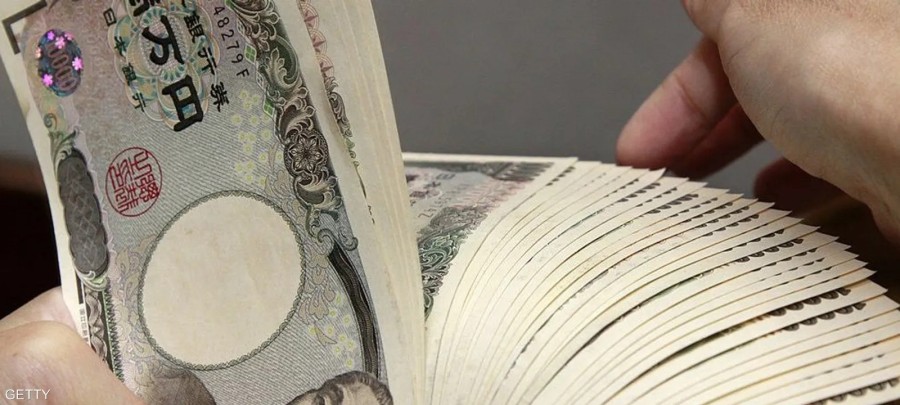


The Japanese yen continued its sharp rise, causing the dollar to decline in global markets, as investors closely monitored the risks of a possible joint US-Japan intervention in the currency market in 15 years.
The latest surge followed a jump on Friday, when the Federal Reserve Bank of New York reached out to traders to examine exchange rates, with the yen rising again by 1.2% to 153.89 against the dollar during Asian trading on Monday.
Meanwhile, the euro reached its highest level in four months, while precious metals such as silver and gold jumped to record highs, exceeding $100 an ounce for silver and $5,000 an ounce for gold.
Haruna Tanaka, executive director of the treasury and securities division at Saitama Resuna Bank in Tokyo, told Reuters: I can't say for sure if there will be an imminent intervention, but at the moment it seems that market players are unwinding their short positions, expecting the yen not to reach 160 against the dollar. In the long term, the yen and dollar are moving sideways as a result of institutional demand for the dollar.
Tim Kelleher, head of institutional foreign exchange sales at Commonwealth Bank of Australia, Auckland, added:
This is the first time in over a decade that the Fed has directly examined a currency. They have threatened before, but to actually go and do it represents a major change in their modus operandi. We are now under a new regime... and we have seen movement against the US dollar. There is sporadic talk of Plaza Accord 2.0, which will have an impact and indicates a weakening dollar.
David Forrester, chief strategist at Crédit Agricole, Singapore, said: “There is a possibility that what is happening is part of a broader trend. The threat of intervention reflects investors’ concerns that Japanese and US authorities would like a weaker dollar. This, coupled with President Trump’s erratic policies, including his threat to impose 100% tariffs on Canadian exports if it signs a trade deal with China, is weighing down the appeal of dollar-denominated assets.”
Moh Seong Sim, foreign exchange strategist at OCBC Bank, Singapore, noted that:
The message this action sends is strong... and I think the market will take it much more seriously than if it were just the Ministry of Finance or the Bank of Japan checking prices. It's rare for the US to intervene directly, and this can be seen as a coordinated attempt to curb the yen's weakness.
The weak yen has become a problem because it is unpopular with the public, who see it as contributing to inflation. The threat of intervention itself may be an attempt to curb the yen's weakness and prevent it from becoming a political issue.
Interest rates in Japan
Masakiko Lowe, senior fixed income strategist at State Street Investment Management in Tokyo, noted in a client note: “In the event of a coordinated intervention in the foreign exchange market, the probability of the Bank of Japan raising its rates this spring increases significantly. Any support from the U.S. Treasury would likely be contingent on an earlier Bank of Japan rate hike and continued monetary policy normalization, with U.S. Treasury bonds being strengthened as Japan’s primary long-term reserve asset. The bottom line: This appears to be evolving into a politically engineered, managed reset, with a reduced risk of disorderly unwinding of yen positions. The key message is discipline and coordination, with a credible, flexible ceiling at 162.”
Joey Chow, head of foreign exchange research for Asia, HSBC, Singapore, said in a note to clients:
Given the frequency of joint interventions during the period from May 1989 to April 1990, it should not be assumed that US involvement is necessarily a game-changer or a definitive solution to the yen's weakness.
Prashant Newnah, senior Asia-Pacific rates strategist at TD Securities, Singapore, noted:
“Takaichi’s public statements and Mimura’s limited comments, along with the emphasis on the Ministry of Finance’s close communication with the US Treasury, mean that the market cannot rule out joint intervention by Japan and the United States. The market bias was to shorten the yen, but the possibility of coordination has made the bet no longer one-way.”
Carlos Casanova, chief economist for Asia at UBP, Hong Kong, said:
The appeal of short positions on the yen recently appears to be waning due to the presence of two-sided risks. The mere expectation of potential intervention could contribute to strengthening the currency. The Japanese yen is likely to stabilize to some extent, despite limited catalysts for a significant advance, while long-term yields are expected to face continued pressure at their current high levels.