


















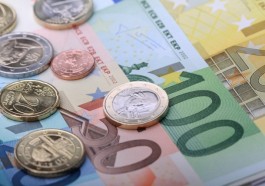
















The euro rose in the European market on Monday at the start of the week's trading against a basket of global currencies, on its way to achieving its first gain in the last four days against the US dollar, benefiting from the decline in the levels of the US currency ahead of the start of the Federal Reserve meeting.
The euro's rise remains limited as investors refrain from building large long positions ahead of the European Central Bank meeting later this week, where European interest rates are expected to remain unchanged.
The European Central Bank is likely to provide clear evidence regarding the likelihood of an interest rate hike next December, especially given the market's tendency to favor such a move due to inflationary pressures and energy prices.
Price overview
Euro exchange rate today: The euro rose against the dollar by 0.2% to ($1.1227), compared to Friday's closing price of ($1.1203), and recorded a low level during today's trading at ($1.1202).
The euro ended Friday's trading down 0.1% against the dollar, its third consecutive daily loss, due to weak economic data in Europe.
The euro lost 0.35% against the dollar last week, its sixth weekly loss in the last seven weeks, due to concerns related to the financial and political situation in France.
US dollar
The dollar index fell 0.2% on Monday, resuming losses that had paused on Friday, and nearing its lowest level in three weeks, reflecting the decline in the US currency against a basket of major and minor currencies.
This decline comes amid a slowdown in purchases of the US dollar as the best available investment, especially with the waning of aggressive expectations about the Federal Reserve's interest rate path.
The Federal Reserve's monetary policy meeting kicks off tomorrow, Tuesday, with decisions to be issued on Wednesday, where US interest rates are widely expected to remain largely unchanged.
The meeting's outcomes are likely to provide strong evidence regarding the likelihood of a US interest rate hike in December, as the Federal Reserve continues to struggle to contain inflation, particularly with rising fuel costs putting additional pressure on prices.
The European Central Bank is meeting on Wednesday and Thursday of this week, amid market expectations that it will keep interest rates unchanged at 2.65%, its highest level since March 2025.
The bank is expected to focus during the meeting on assessing the impact of previous interest rate increases on economic activity and financing conditions, particularly in light of recent financial developments in France, Italy and Spain.
This comes at a time when inflationary pressures are mounting on monetary policymakers at the European Central Bank, particularly with continued wage growth and rising energy costs and import prices, which may prompt the bank to adopt a more hawkish tone and emphasize its readiness to continue raising interest rates gradually.
Markets will be focusing intensely on comments from ECB President Christine Lagarde and the monetary policy report, looking for clearer signals on the timing of the next rate hike, especially as market bets on an interest rate increase in December are growing.
European interest rate
The probability that the European Central Bank will leave interest rates unchanged at this week's meeting has settled at 99%, according to market pricing.
The probability of the European Central Bank raising interest rates by a quarter of a percentage point at its December meeting has settled at 70%.
FX News Today's view is that the euro is expected to remain volatile this week, with anticipation of the European Central Bank meeting which could prove to be a significant turning point in the currency's direction.
Although holding European interest rates steady seems the most likely scenario, if the bank adopts a more hawkish tone and gives signals that pave the way for a rate hike next December, it could give the euro additional support and open the way for its rise against a basket of currencies.
Conversely, concerns about the gap between European and US interest rates may limit upside opportunities, especially if the results of this week’s Federal Reserve meeting are also more hawkish.
Accordingly, we expect the euro to continue moving sideways in the near term, with a positive bias contingent on clear signals from the European Central Bank regarding the resumption of monetary policy tightening in the coming period.