


































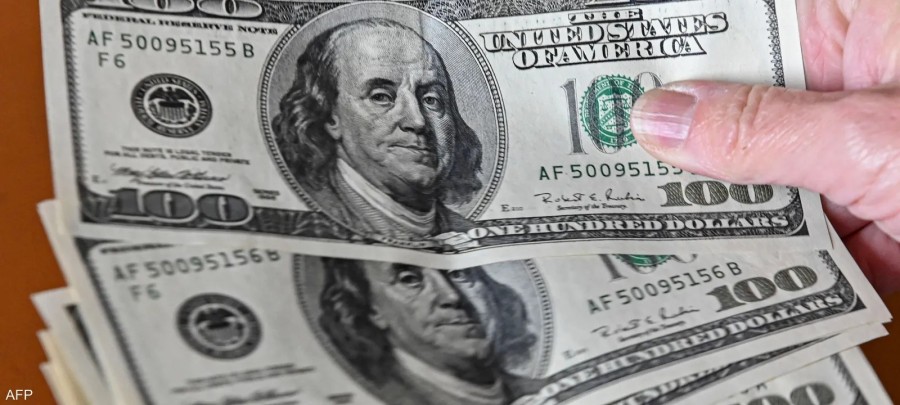


The US dollar continued its gains against major currencies during Wednesday's trading, as investors awaited a series of speeches from top central bank officials, most notably from US Federal Reserve Chairman Kevin Warsh, at a time when market bets are increasing on the possibility of raising interest rates in the coming period.
The spot dollar index rose 0.2%, after posting gains of 0.6% during the last quarter, supported by expectations of continued tight monetary policy in the United States.
In contrast, the Japanese yen fell 0.1% to 162.71 yen to the dollar, after earlier in the week hitting its lowest level in 40 years, while the South Korean won approached its weakest level since the global financial crisis, affected by the continued outflow of foreign investment from the Korean stock market.
Interest rate bets are weighing on gold and supporting the dollar.
Gold fell 0.8% to around $3,975 an ounce, amid rising expectations that the Federal Reserve may raise interest rates, which reduces the appeal of the non-yielding yellow metal.
Silver and platinum prices also fell, while stock markets moved mixed, and US Treasury bonds were relatively stable in Asian trading, after the yield on 10-year US bonds rose by 9 basis points during Tuesday's session.
David Forrester, chief strategist at Credit Agricole CIB in Singapore, said that rising U.S. Treasury yields are providing broad support for the dollar ahead of the Federal Reserve chairman's speech later today, as well as the anticipated U.S. jobs data tomorrow.
A crucial week for global markets
Global markets face a crucial week, as investors await speeches from US Federal Reserve Chairman Kevin Warsh and European Central Bank President Christine Lagarde, before turning their attention to the US jobs report for June due on Thursday, which could provide crucial clues about the future path of interest rates.
These events come after a strong performance in global markets during the last quarter, as investors largely ignored geopolitical tensions and continued to pour money into AI-related stocks.
Meanwhile, traders in the federal funds rate forward market have begun increasing their bets on the likelihood that the Federal Reserve will start raising interest rates as early as the July meeting, a scenario that was considered unlikely a short time ago, but which remains contingent on the results of upcoming economic data.
Economic data reinforces the tightening scenario.
Economic data released Tuesday showed that the number of job openings in the United States remained largely stable during May, reflecting continued strong demand for labor, while the consumer confidence index rose slightly during June, supported by lower fuel prices which partially offset concerns about the labor market.
Nevertheless, the chances of an interest rate hike at the July meeting remain limited, with swap markets pricing in a probability of around 9 basis points from a 25 basis point increase, or approximately 36%.
This jump in expectations is a major shift compared to the period before Kevin Wollasch took over as chairman of the Federal Reserve, when markets almost ruled out any possibility of raising interest rates, before Wollasch refocused on the priority of price stability and combating inflation.
Federal Reserve officials are scheduled to hold their next meeting at the end of July, after unanimously deciding at last month's meeting to keep interest rates unchanged.
Asian currencies are under pressure, and the yen is nearing critical levels.
The dollar's rise continued to exert strong pressure on Asian currencies, with analysts believing that the continued strength of the US currency could push the South Korean won to new record lows.
Moon Daewon, an economist at Korea Investment & Securities, said that the continued strength of the dollar makes it not unlikely that the won will hit new lows.
The won fell as much as 0.6% to 1,559.10 won to the dollar, after dropping last month to 1,562.20 won, its weakest level since March 2009.
In Japan, the yen's decline to below 162 yen to the dollar has led many analysts to predict a target of 163 yen and possibly higher levels, with a growing belief that the Japanese Ministry of Finance may tolerate greater currency weakness than during its intervention campaigns in 2024.
In this context, Japan’s top currency official, Atsushi Mimura, refrained from repeating the traditional statements about the government’s readiness to intervene decisively in the foreign exchange market, but he stressed that Japan’s intervention to support the yen two months ago had achieved its goals, and that some US officials had expressed their support for that move.
Stocks lose momentum after a strong rally
Asian stock markets lost momentum after a two-day rally, as investors reduced risk following a strong surge in chip and technology stocks that had led markets to their best quarterly performance in 17 years.
Futures contracts also indicated that the wave of caution could extend to European and American markets during upcoming trading sessions.
Christina Won, portfolio manager at East Spring Investments, said that selectivity will be the most important factor during this quarter.
She added that the biggest source of concern is the significant rise in stock prices, along with increasing volatility, stressing that investors need to focus on selecting companies whose valuations are still supported by strong financial fundamentals and whose prices have not risen to levels exceeding their true value.