
















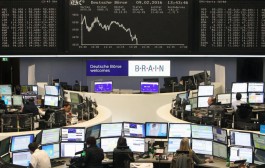













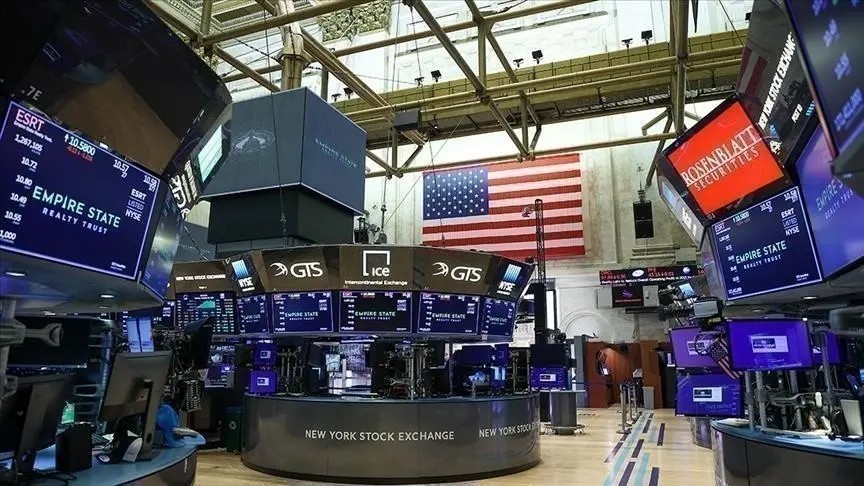


Major U.S. indexes ended their second straight week of losses on Friday, as investors monitored a barrage of geopolitical headlines and tried to cope with a still-turbulent trading environment at the start of 2026.
The S&P 500 moved marginally on Friday, rising less than 0.1%, but ended the week down 0.4%, while the Dow Jones Industrial Average posted a weekly decline of 0.7%. The Nasdaq Composite, despite rising 0.3% on Friday, finished the week down nearly 0.1%.
The most notable movement during the week came from the natural gas market, where futures jumped nearly 75% during the five trading sessions through Thursday, as a powerful winter storm swept through, bringing polar cold and heavy snow to more than 150 million people in the United States.
Davos reveals cracks between Washington and its allies
The week's top stories emerged from the World Economic Forum in Davos, where world leaders and leading economic figures gathered. The forum resulted in the announcement of a framework agreement on Greenland between President Trump and European leaders, but the discussions also revealed a widening rift between the United States and several of its key Western allies.
In recent years, the currency market has lost ground to the dominance of equities, with investors focusing on earnings growth, optimism fueled by artificial intelligence, and the strong performance of US stocks. However, this situation may be starting to change, according to several strategists.
Analysts believe that the Greenland agreement may address the immediate problem of tariffs or military threats, but it does not address the core of the crisis, which is a growing sense of mutual alienation between the United States and its allies, potentially leading to a more divided world in which the dollar's status declines.
Clear movements in the currency market
Despite easing tensions over Greenland and the European Union suspending counter-trade measures, investors appear more inclined to seek safe havens outside the dollar.
In just 5 days, the euro/dollar pair rose by about 2%, reflecting the strength of the European currency against the US dollar.
Meanwhile, the dollar fell more than 2.7% against the Swiss franc, signaling increased hedging against systemic instability, and also declined by about 1.8% against the Japanese yen as the Japanese currency strengthened at the end of the week.
A week full of decisions and results
Investors are turning their attention to one of the busiest weeks of the year, with the Federal Reserve meeting in January coinciding with a slew of corporate earnings reports, including four from the Big Seven.
Microsoft, Meta and Tesla will announce their results after Wednesday's session closes, while Apple will announce its results after Thursday's session closes, with markets focusing on the size of spending on artificial intelligence and these companies' ambitions in the next stage.
In monetary policy, markets are almost certain that the Federal Reserve will keep interest rates unchanged within the range of 3.5% to 3.75%, with data indicating a 97% probability of holding rates steady at the next meeting.
The most important issue for the Federal Reserve may not be the interest rate decision itself, but rather the developments surrounding President Trump's nominee to head the Fed after Jerome Powell's term ends in May. Speculation has been mounting that Rick Rieder of BlackRock is emerging as the leading candidate, ahead of other names that were previously considered strong contenders.
Ratings and huge spending spark controversy
As the results announcements from major technology companies approach, investors are awaiting two key answers: the size of the spending on artificial intelligence and cloud computing, and how that spending will be financed.
Meta raised its spending estimates to a range of $70 billion to $72 billion, while Microsoft indicated that its spending in 2026 would exceed the $88.2 billion it spent in 2025.
This massive spending is being financed through the issuance of so much debt that it has begun to reshape the investment-grade bond market, with technology companies issuing nearly $700 billion in debt in just one quarter.
Despite the decline in talk about an AI bubble, analysts still warn of the risks of high valuations and unlimited open-ended spending, stressing that the technological revolution is real, but the timing of investment and price levels remain crucial factors.
Super course in metal markets
In a global environment fraught with geopolitical tensions from Venezuela to Iran, Greenland and US-European relations, metals continue to dominate the investment landscape.
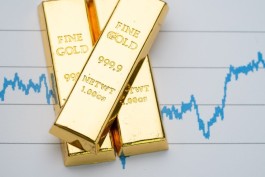
Gold rose by about 8% in one week and surpassed the $4,900 per ounce level for the first time, prompting major banks to raise their price forecasts to $5,400 by the end of the year.
Silver, for its part, surpassed $100 an ounce for the first time, while platinum jumped by more than 30% since the beginning of the year, in a clear reflection of investors' shift towards solid assets.
Analysts believe that what is happening today is different from the past, as the dollar is no longer the first refuge when crises escalate, but rather gold, silver, precious metals, and even defense stocks are attracting the attention of investors.
Industrial demand fuels the upward trend
The rise in metals was not limited to investment demand, but also extended to the industrial side, with copper prices rising by about 4% since the beginning of the year, driven by demand related to data centers.
Lithium has risen by nearly 44% this year, while tin has jumped by about 30%, amid expectations that demand will continue to grow as technology companies expand into building artificial intelligence infrastructure.
Major banks estimate that supply constraints and strong demand related to the energy transition and artificial intelligence could support metal prices through 2026, and may even establish something resembling a supercycle that keeps prices above their historical averages for a long period.