


















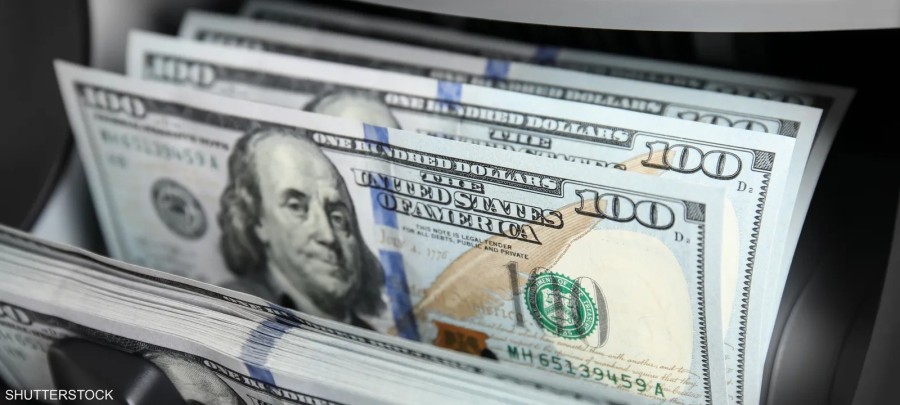
The US dollar rose to its highest level in about two weeks during trading on Monday, as the conflict in the Middle East pushed up oil prices and investors turned to the safe-haven currency, particularly affecting the yen, which had recently made strong gains.
Warnings from the heads of advanced artificial intelligence companies about the potential risks of the technology also weighed on stocks and boosted the dollar, while increasing bets on the Federal Reserve raising interest rates on Wednesday supported the US currency.
In trading, the US dollar index, which measures the currency’s performance against a basket of six major currencies, rose by about 0.5% to 99.59, its highest level since September 2.
The euro fell to a one-month low of $1.153, down more than 0.5%, while the pound sterling fell 0.4% to $1.348.
The rise in oil prices has increased investor anxiety and pushed global bond yields back towards their highest levels in several years, with Brent crude climbing 3% to $108 a barrel.
Houthi attacks on Saudi Arabia, the world's largest oil exporter, which came after the kingdom shut down its main pipeline (which bypasses the Strait of Hormuz), have increased concerns about energy supplies.
Diplomatic efforts to resolve the conflict between the United States and Iran appeared to be faltering, with a planned meeting between Tehran and other Gulf governments being postponed. Attacks on ships in the region also heightened concerns about supply disruptions.
The Japanese yen is among the most prominent declining currencies, giving up some of its recent strong gains that came with the support of increasing bets on the Bank of Japan raising interest rates.
The dollar rose 0.7% against the Japanese currency to 154.61 yen, compared to below 153 yen, the level the yen touched last week, its highest level in nearly seven months.
Central banks under pressure
The key question facing markets this week is whether the Federal Reserve will raise interest rates on Wednesday in response to a surge in energy prices that has pushed diesel prices to record highs and contributed to core inflation rising more than expected in August.
Money markets on Monday indicated a near 90% probability of an interest rate hike, compared with about 60% a week earlier, according to the CME Group's FedWatch tool.
Increased bets on rising interest rates worldwide have pushed bond yields to their highest levels in years or even decades in the United States, Europe, and Japan. So far, the impact on the currency market has been relatively limited, with yields largely moving in tandem.
Markets almost certainly expect the Bank of Japan to raise interest rates on Friday, while they will be looking for clues as to whether further increases are forthcoming.
There are signs of a shift in market sentiment towards the yen, with speculators moving to establish net long positions on the Japanese currency for the first time since February.
The Bank of England is expected to leave borrowing costs unchanged on Thursday, but traders now anticipate a rate hike later this year and further increases in 2027, after the European Central Bank raised interest rates last week.

UAE's Mubadala leads a $400 million financing round for German insurance company Wefox
Wefox, an insurance technology company founded by former emp.. Read more

Saudi Arabian Centers distributes dividends to shareholders for the second half of 2022 with a total of 356.25 million riyals
Arabian Centers Company has approved the distribution of cas.. Read more

The largest sovereign funds: "Abu Dhabi Investment Authority" advances to third place globally, with assets of $708.8 billion
The Abu Dhabi Investment Authority has advanced to the third.. Read more
Accumulated losses place Emirati companies on the "second category" screen, pending anonymity
Special Report - (Namazone): A group of companies listed.. Read more

Details 142 Saudi initiative to face the consequences of "Corona" B214 billion riyals
Special Report (Nmazzon): The government announced that.. Read more

Will gold remain a safe haven asset?
Gold has long been a source of controversy and contention am.. Read more
Global trade is expected to decline in the coming months
The economics department of Qatar National Bank (QNB) said t.. Read more

Analysis .. How will major central banks respond to the increasing cases of financial instability?
The global macroeconomic environment is experiencing some of.. Read more

The euro is below the dollar .. the lowest level in 20 years
For the first time in 20 years, the euro fell below $1 on Tu.. Read more
"OPEC"...The pressures of supply shortage will continue next year
OPEC expected global demand for oil to increase next year, b.. Read more
The dollar rose to its highest level in nearly two weeks as the public awaited the Federal Reserve meeting.

NamaaZone " The Power of Knowledge"


Analysis Service |
Its a free service for technical consultation provided by NamaaZone to the website visitors. |
Open account Request |
NamaaZone provides a range of integrated trading solutions in local and global financial markets |