






















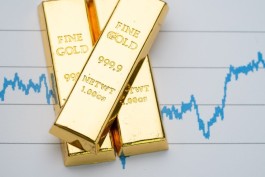
















Goldman Sachs has released a comprehensive report on gold's 2025 outlook and the drivers of its price movement, outlining the potential trajectory for gold. According to Goldman Sachs' 2026 Commodities Outlook, gold is the best bet across the entire commodities market for the coming year, with the potential to surpass its $4,900 per ounce price target if retail investors join central banks in diversifying their portfolios.
Here are the key points and statistics included in the report:
1. The role of central banks: a structural driver of price
The bank expects central bank demand to remain very strong in 2026, which will contribute 14% to the expected rate increase by December 2026.
Average monthly purchase: The bank expects to purchase 70 tons per month in 2026.
Historical comparison: This rate is close to the average of the past 12 months (66 tons), but it is 4 times higher than the pre-2022 average of 17 tons per month.
Reasons: The freezing of Russian reserves in 2022 changed the concept of geopolitical risk, in addition to the Chinese (PBoC) desire to internationalize the yuan while keeping the share of gold in its reserves relatively low compared to peers.
2. Private investors: The next fuel for the rise
Analysts believe there is a significant gap in individual gold holdings, representing an opportunity for further gains:
Current share of gold: Gold exchange-traded funds (ETFs) currently represent only 0.17% of private portfolios in the United States.
Compared to the peak: This level is 6 basis points lower than the 2012 peak.
Buying effect: Goldman Sachs estimates that every one basis point (1bp) increase in the share of gold within US portfolios raises the price of gold by 1.4%.
3. Expected price trajectory for 2026
The bank outlined a roadmap for the price of gold over the coming year:
First quarter 2026: Expect a temporary correction to levels of $4,200.
Second quarter 2026: Return to levels of $4,400.
Third quarter 2026: A new record high of nearly $4,630.
Q4 2026: Reaching the ultimate target of $4,900 per ounce.
4. Commodities as a means of insurance against risks
The report emphasized the insurance value that commodities provide amidst the geopolitical conflict and the technological (AI) race between the US and China. The bank warned that equity and bond portfolios are not sufficiently diversified to withstand supply shocks that could lead to both high inflation and weak growth—a scenario from which commodities would directly benefit.