










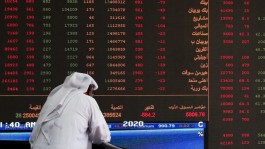


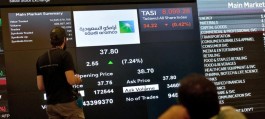



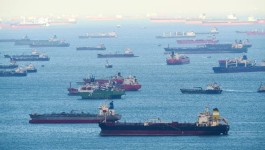














Global oil markets experienced a major shock during the first week of March, as the US-Israeli conflict with Iran escalated, pushing prices to their highest levels since 2023 after Brent and US crude futures surged to record highs, amid growing fears of disruptions to global supplies, particularly in the vital Strait of Hormuz.
With this escalation, markets have begun to reprice risks, not only at the geopolitical level, but also at the operational level of production and transportation.
In light of this tense atmosphere, attention is turning to the ability of the global economy to withstand record highs in energy prices, amid the possibility that crude oil could reach record levels of up to $150 per barrel, which could have direct repercussions for both markets and consumers.
Oil price developments
Oil prices rose by about 30 percent in the first week since the start of the Iran war, under the weight of escalating supply concerns, to reach their highest level since 2023.
Brent crude futures had ended February at $72.48 a barrel, then rose by about 28 percent in the first week of March, to settle at $92.69 a barrel at the end of the week.
As for US crude oil futures, they jumped from $67.02 a barrel at the end of last week to $90.90 a barrel at the end of this week, recording gains of about 35.6 percent (the largest gain in the history of futures trading since 1983).
On March 2 (the first trading days after the start of the military escalation in the region): US crude futures rose to settle at $71.23 a barrel. Brent crude futures also rose to settle at $77.74 a barrel.
The following day (March 3), US crude rose to $74.56 at settlement, and Brent crude climbed to $81.40 at settlement.
On March 4, Brent crude settled at $81.40 per barrel, and US crude rose to $74.66 per barrel.
On March 5, Brent crude futures settled at $85.41 a barrel, while U.S. crude futures settled at $81.01 a barrel.
In the final session of the week's trading, US crude futures rose to $90.90 a barrel, and Brent crude futures climbed to $92.69 a barrel.
On Friday, US President Donald Trump demanded Iran's unconditional surrender, raising fears of a protracted war that could severely damage the global oil and gas market. This comes after the conflict paralyzed shipping in the Strait of Hormuz, a vital waterway for energy supplies.
The Financial Times quoted Qatari Energy Minister Saad al-Kaabi as saying earlier that crude oil prices could reach $150 a barrel in the coming weeks if oil tankers are unable to pass through the Strait of Malacca. Al-Kaabi added that this could lead to the collapse of the global economy.
The Trump administration on Friday announced a $20 billion reinsurance program for oil tankers in the Gulf, although the measure did little to calm the crude oil market.
Fires of conflict
Dr. Wafaa Ali, Professor of Economics and Energy, told Sky News Arabia's economic website:
The most prominent question in light of the ongoing war is how markets will adapt to events under the fire of conflict.
The oil and gas markets appear to have read between the lines and have begun pricing themselves out of control after prices exceeded $90 a barrel for oil.
The risk premium has imposed its will, driven by clear geopolitical panic, reflecting that markets have already priced in the risk of supply disruptions effectively.
The current conflict is no longer just a passing tension, but has turned into something resembling a blow to the global energy equation, where the risk premium has become a structural element in the oil pricing structure.
She adds that the reality on the ground reveals a partial paralysis in oil production (...) noting that the state of force majeure has come to dominate the scene in the energy markets.
She points out that prolonging the conflict is shaping a new future for global energy security, given the rising costs of insuring oil shipments, describing what is happening as an economic earthquake hitting the global economy, especially with about one-fifth of global oil production remaining hostage to the accumulation of tankers in front of the Strait of Hormuz waterway.
She asserts that what is happening cannot be considered merely a political dispute, but rather represents a comprehensive reshaping of the global energy landscape and the balance of economic power. She emphasizes that the oil market is unlike any other market; it is an interconnected market highly sensitive to geopolitical developments.
She concludes by noting that:
The markets are experiencing a pivotal moment as geopolitical tensions escalate, with their repercussions affecting various global markets, especially energy markets, thus redrawing the geopolitical map.
Markets are now pricing in potential catastrophic scenarios, not just facts. Whereas the talk used to be about a surplus in supply, the world is now talking about supply chain bottlenecks and disruptions, amid a state of price shock driven by fears related to the Strait of Hormuz, which, at peak times, saw an oil tanker pass through every six minutes, which is why oil today is pricing war with sharp jumps.
Pricing of risks and operational disruptions
A report by CNBC quoted Natasha Caneva, head of global commodities research at JPMorgan Chase, as saying in a note to clients:
The market is shifting from pricing purely geopolitical risks to dealing with tangible operational disruptions.
Production cuts could reach 6 million barrels per day by the end of next week if the Taiwan Strait is not opened to shipping traffic.
A report in the Financial Times quoted Arne Rasmussen, chief analyst at Global Risk Management, as saying that the market is underestimating the potential duration of the war, adding that there is a snowball effect as traders wake up to the risks.
inflationary pressures
Joe Yarak, head of global markets at Cedra Markets, told Sky News Arabia's economic website:
Oil prices have already exceeded $90 a barrel.
These increases come at a time when the Qatari energy minister has warned that a longer-term crisis could affect the production of some exporting countries, putting pressure on global supplies in the medium and long term.
There is a high probability that oil prices will exceed $100 or even $110 per barrel.
He emphasizes that rising oil prices increase inflationary pressures, explaining that with regard to the US economy, markets have already begun to reprice their expectations for the Fed's decision, as investors' bets on three interest rate cuts during 2026 have fallen to the possibility of only two cuts, with the first cut likely to be in September.
Yarak points out that, from his perspective, the year may not see any interest rate cuts if inflationary pressures continue, especially with the recent decline in labor market data by about 92,000 jobs, which puts the Fed in a real dilemma between curbing inflation and maintaining a balanced labor market.
He explains that the greatest risk lies in the possibility of the US economy entering a phase of stagflation, meaning high inflation coupled with weak economic growth. According to his estimates, if oil and gas prices remain at their current high levels, they could add between 0.3 and 0.9 percent to US inflation rates, while inflation could reach nearly 4 percent if oil prices rise to around $120 per barrel.
He also points out that pressures are already beginning to show on the American consumer, with the price of a gallon of gasoline currently at about $3.35, warning that a rise to between $3.50 and $4 would constitute an economic and political burden, especially on the Donald Trump administration before the midterm elections.
Yarak concludes by saying that the decisive factor in all these scenarios remains the duration and scope of the war, suggesting that it will be a long war of attrition, which will put central banks globally, especially the US Federal Reserve, to a difficult test in managing monetary policy, given the strength of the dollar and the high yields on US bonds.
Predictions
Barclays Bank said in a report on Friday that Brent crude could reach $120 a barrel if the conflict in the Middle East continues for several more weeks.
Barclays added that these figures may seem very high, especially given the prevailing pessimism about the oil market outlook at the start of this year, but we reiterate that the fundamentals are stronger and the risks are greater than the conflict between Russia and Ukraine, when we saw these levels materialize, according to the report published by Reuters.
Barclays reported that the amount of oil stuck on tankers in the Gulf of Mexico has increased by about 85 million barrels since the start of the conflict, adding that the risks of rising oil prices are still tilted towards increasing.