














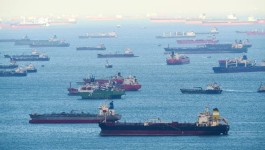

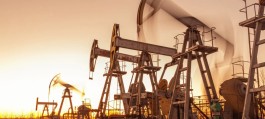












A fragile ceasefire in Iran has kept oil prices hovering below $100 a barrel, as markets assess the prospects for peace or renewed escalation. Bloomberg Economics' baseline scenario of a less intense conflict somewhere in between lies somewhere between these two possibilities.
The impact on the global economy is slower growth of 2.9% in 2026, down from 3.4% last year. Global inflation, which is already accelerating, could peak at around 4.2% in the fourth quarter, up from 3.1% at the end of last year.
We anticipate that central banks will keep interest rates unchanged in the second quarter before resuming cuts. We also outline a bearish scenario in which oil reaches $170 and a bearish scenario in which it returns to $65. For the global economy in 2026, the difference between these two scenarios exceeds $1 trillion in GDP.
The beginning of the impact of the Iran war on global growth
The index indicates that the war is weighing on global growth. The global economy appears to have slowed sharply in March, after the US and Israel launched their war with Iran. Bloomberg Economics' global growth tracker points to a sharp reversal after the momentum built up at the start of the year.
This tracker uses a machine learning algorithm to extract signals from data on 18 advanced and emerging economies. It provides an early reading of output, based on business surveys conducted a few days after the end of the month.
As for inflation, early readings from Europe and our big data tracker for the United States show a sharp acceleration in price increases, with fuel costs being the main driver.
Global growth slows to lowest level since the coronavirus pandemic.
The impact of the war on growth is complex. Generally, high oil prices are good news for producers like the United States, Russia, and Saudi Arabia. However, this assumes their ability to get their oil to market, which poses a problem for Saudi Arabia and other Gulf states. Consumers like the European Union, China, and India are the ones who ultimately pay the price.
In the baseline scenario, global growth slows to 2.9% in 2026 from 3.4% in 2025, the weakest since 2020. Spending on artificial intelligence is a positive factor offsetting the costs of war.
If the war escalates and oil prices rise, the blow to global growth will deepen, with GDP expected to grow by only 2.2%. If the ceasefire holds and oil prices return to pre-war levels, our forecast rises to 3.1%. The difference between the best and worst-case scenarios is slightly more than $1 trillion, roughly equivalent to Switzerland's annual GDP.
Global inflation is poised to rise due to the Iranian oil shock.
Higher oil prices are passed directly onto gasoline costs, and indirectly boost prices for logistics, plastics, fertilizers and other inputs within consumer prices.
The early effects of the war are already becoming apparent. Consumer price index readings jumped in March in Europe. Our big data project for the US price index indicates a rise to about 3.3% from 2.4% in February.
In the baseline scenario, we see global inflation reach 4.2% in the fourth quarter, up from 3.1% at the end of 2025.
In the escalation scenario, price increases peak at 5.4% in the fourth quarter, the highest since mid-2024. In the ceasefire scenario, the rise reaches 3.7%, which is closer to a temporary wave within the path of declining inflation, rather than an interruption in the trend.
Central banks are bracing for an oil shock.
The response of central banks to the shock of a war with Iran will reflect the balance of risks between inflation and employment, the level of concern about inflation expectations, and in some cases, political dynamics.
In the baseline scenario, the global interest rate stabilizes at around 5% in the second quarter, before gradually declining to 4.7% by the end of the year.
In an escalation scenario, a larger inflationary shock would push the rate to 5.3% in the fourth quarter. In a ceasefire scenario, the cuts would continue, and the year would end at 4.6%.
Among the major economies: the Federal Reserve is inclined to lower interest rates, supported by stable underlying prices. The Bank of England may be forced to raise them due to high inflation. The European Central Bank is likely to face pressure to tighten, but its response will be limited. For the Bank of Japan, the war presents an opportunity to continue raising interest rates gradually.
America's growth depends on artificial intelligence and oil.
We were expecting the US economy to grow above its potential level in 2026, driven by AI investments and fiscal stimulus, with inflation approaching the Federal Reserve's 2% target. Then came the shock of the Iran war.
In the new baseline scenario, higher oil prices reduce 2026 growth by 0.5 percentage points to 1.8%, in line with the long-term trend. Higher gasoline prices and tighter financial conditions will weigh on activity.
This will be partially offset by higher tax revenues this year, increased investment from oil producers, and higher defense spending. The April 7 ceasefire also increases the likelihood of above-trend growth in 2026, provided it holds.
Inflation will rise in the near term before slowing in 2027 due to base effects. The Federal Reserve will keep its benchmark interest rate unchanged until the unemployment rate reaches 4.8% in the fourth quarter of 2026, at which point we expect a 50-basis-point cut, followed by an additional 75 basis points in 2027.
Eurozone growth slowed due to energy and tariffs
The outlook for the eurozone is being reshaped by rising commodity prices, adding to the pressures from higher US tariffs that were already weighing on activity.
In the baseline scenario, which assumes oil prices are near $105 per barrel in the second quarter of 2026 before falling to around $85 by year-end, GDP growth slows to 0.7% in 2026 from 1.4% in 2025. This compares with the pre-war forecast of 1.0% for 2026. A decline in oil prices would support a recovery in growth to 1.0% in 2027. A lasting ceasefire would start the recovery even sooner.
This commodity shock could push headline inflation to 2.9% in 2026 from 2.1% in 2025, before base effects push it down to 1.9% in 2027. A limited shift to core inflation would keep it low at 1.9% in both 2026 and 2027. In response, the European Central Bank might raise interest rates once by 25 basis points in June 2026.
Britain under pressure from stagflation and energy
Before the outbreak of the Iran-Iraq War, the UK was facing a difficult combination of slow growth and above-target inflation. Higher energy prices will exacerbate these trends, although the precise extent remains uncertain.
Assuming gas prices remain around £1.40 per BTU in 2026, and oil averages $105 per barrel in the second quarter of 2026 before falling to around $85 in the fourth quarter, inflation is likely to reach 3.3% in the fourth quarter of 2026. This is 1.3 percentage points higher than the pre-war baseline scenario. Annual GDP growth is likely to be only 0.5% this year. We anticipate the Bank of England will keep interest rates unchanged in response, meaning rates will end the year 50 basis points higher than pre-war forecasts.
The ceasefire between the United States and Iran has shifted the balance of risks toward a more moderate outcome. In a scenario where energy costs return to pre-war levels by the fourth quarter of 2026, the peak in inflation would be 0.4 percentage points in the third quarter of 2026. This could pave the way for an interest rate cut by the Bank of England by the end of the year.
China's growth depends on the resilience of global demand.
China has buffers to absorb the shock of a war with Iran, including its oil reserves, its ability to curb price increases, and its capacity to secure energy from other sources. With overall prices under downward pressure due to oversupply, it also has room to absorb the inflationary boost.
However, a prolonged war would pose greater threats, as the destruction of demand in foreign markets and the disruption of supply chains could harm exports, the main engine of growth.
The two-week ceasefire offers some relief, but risks remain high. Beijing is likely to provide some stimulus, perhaps through a combination of moderate fiscal support and interest rate cuts. In the baseline scenario, where the conflict subsides, stronger policy support could help achieve growth at the lower end of the government's 4.5% to 5% target range for 2026. However, if the conflict is prolonged and impacts global demand, the outlook will be more challenging.
Inflationary pressures push Japan to raise interest rates
Japan faces significant stagflationary pressures due to the Iran war. In the baseline scenario, high energy prices will push inflation to around 5% in early 2027. A decline in purchasing power will contribute to a slowdown in growth to 0.2% this year from 1.0% in 2025.
We expect the Bank of Japan to raise interest rates twice this year, in April and September, bringing the target interest rate to 1.25%, instead of a single move in July in the baseline pre-war scenario.
The weak yen and strong wage growth are fueling inflation expectations. The Bank of Japan will be concerned that oil-driven price increases are adding further pressure. We believe it will stop at two rate hikes, given the Takaichi administration's pro-stimulus stance. However, bringing forward the second hike to September, at a faster pace than the market anticipates, would signal its focus on price stability.
India's growth forecast lowered due to energy shock
The Iran-Iraq War pushed India, once considered a moderately balanced economy, into stagflation. In our baseline scenario, which assumes average oil prices of $90 per barrel in India’s fiscal year 2027, we expect growth to reach 5.9%, down from our pre-war estimate of 7.5%.
Higher fuel prices, fertilizer and gas shortages, rising yields, and declining stock markets will weigh on growth. Capital outflows, reduced remittances, and export losses due to shipping disruptions will exacerbate the shock. A sustained ceasefire could bring us closer to a lower oil price scenario, boosting growth to 7.3%.
In our baseline scenario, we anticipate inflation at 4.6%, with fuel prices remaining unchanged as oil companies and the government absorb losses. We expect the Reserve Bank of India to maintain its current policy stance for an extended period. However, should the ceasefire collapse exacerbate the energy shock, a scenario of higher oil prices would push inflation to 6.7% and trigger a 50 basis point interest rate hike starting in the fourth quarter of 2026.
Saudi Arabia's growth resilience is supported by the diversification of oil routes.
A war with Iran would strike at a cornerstone of the Saudi economy: oil. Despite heightened uncertainty, the baseline scenario projects growth of 2.9% in 2026. This represents a slowdown compared to last year and is below both the consensus forecast and the average for this century. However, in the context of an unprecedented regional conflict, this performance is considered resilient.
The reason is simple: most of the oil is still flowing, and prices are much higher. A crucial factor is a pipeline running from the east to the Red Sea, bypassing the Strait of Hormuz, which has kept exports flowing despite the war.
While production volumes may have fallen by about 30% since the start of the conflict, prices have risen even further, likely boosting oil revenues. The main risk lies in security; a collapse of the ceasefire and attacks on Red Sea infrastructure could disrupt exports, leading to higher oil prices but lower Saudi revenue.