




































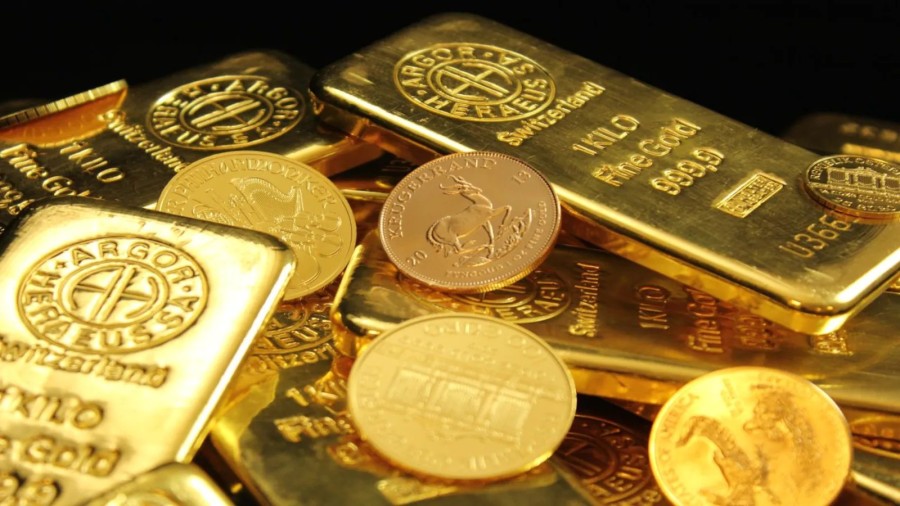


Despite renewed threats of a possible interest rate hike in September, gold's price performance during August proved how strong this precious metal is as an ideal hedge against the unsustainable rise in global sovereign debt levels.
In a report published Wednesday, the World Gold Council (WGC) revealed that investment demand for gold-backed exchange-traded funds (ETFs) saw its second-largest inflow in history. According to its monthly data, up to $18 billion flowed into gold ETFs globally during August, led by funds listed on North American and European exchanges.
The council's analysts explained in the report: Year to date, total global inflows into gold exchange-traded funds (ETFs) have reached $29 billion, representing an increase in holdings of 160 tons. Asian funds remain the largest contributors to these inflows during this period, followed by European funds.
The report added that rising long-term bond yields, coupled with the US Treasury's intervention on August 19, exacerbated concerns about fiscal sustainability and revived the specter of dollar devaluation. With gold breaking through key technical levels, the continued price momentum attracted further institutional and tactical demand.
Record numbers in America and Europe
North American funds attracted approximately $7.7 billion last month, marking their third-largest monthly inflow on record. Analysts noted that this strong August inflow helped offset the record outflows of $13 billion in March, bringing net inflows in North America back into positive territory year-to-date.
Across the Atlantic, European funds saw record inflows of $7.9 billion, the largest ever. Analysts explained this by saying that gold's role as a portfolio diversification tool and a safe alternative to sovereign debt remains a key driver of demand. The continued strong buying spree following the July rally suggests that investors viewed the summer price correction as a golden opportunity to rebuild strategic positions rather than reduce their exposure.
Asian demand continues to provide support
Asian demand continued to play a pivotal role in the gold market, with regional exchange-traded funds (ETFs) attracting $2 billion. China led the way, with analysts noting that the stabilization and recovery of domestic gold prices has whetted investor appetite, putting the market on track to surpass the record set in fiscal year 2025. The continued decline in local government bond yields and the sideways movement of the stock market also provided additional support.
Will the Federal Reserve succeed in controlling yields?
In a separate report, the World Gold Council indicated that the trajectory of investment demand in the coming period will largely depend on the market's confidence in the ability of the US Treasury to curb bond yields, especially since the yield on 10-year bonds is currently trading at 4.83%, its highest level in three years.
Analysts explained that the most important question is not the form of intervention or who implements it, but rather how the markets will interpret it. While the Treasury has considerable leverage, the Federal Reserve has virtually unlimited power should it decide to intervene; this means that curbing nominal yields is almost certain, but the pressure will shift in other directions.
If the markets perceive this intervention as a desperate measure, it could be reflected in a decline in real returns, a widening term premium, a weaker dollar, or even crowding out private sector demand for these assets.
The report concluded: Ultimately, it comes down to market conviction. If the market isn't convinced, gold will be the biggest beneficiary. But if it is convinced, gold may temporarily lose one of the key pillars that has driven its gains over the years. Given current spending and tax commitments, achieving this conviction remains a difficult challenge.