



























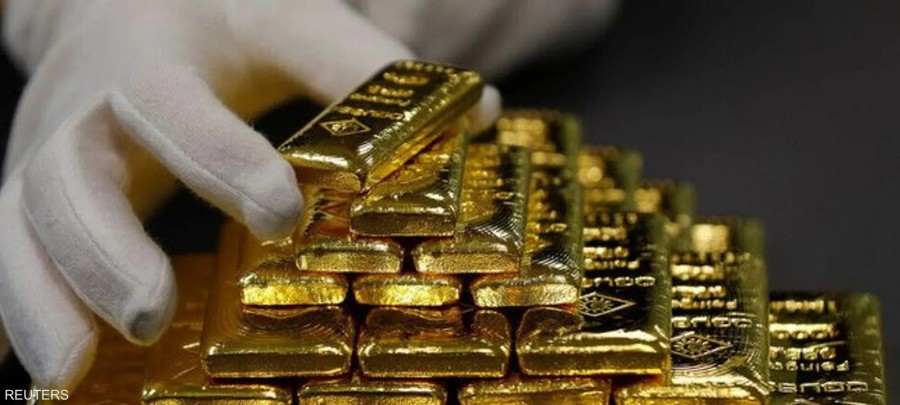


Gold continued its biggest gains in six months, after signs of progress toward resuming shipping through the Strait of Hormuz gave investors a new reason to reduce their bets on a tightening of US monetary policy, in a remarkable turnaround for a metal that has lost about a fifth of its value since the outbreak of war between the United States and Iran in late February.
The precious metal rose as much as 1.4%, briefly surpassing $4,300 an ounce, before paring gains to trade slightly below that level. This followed a 4.1% surge in the previous session, marking its biggest daily gain since February 3. The move was also supported by a breakout from a key technical resistance level, which spurred further buying after gold's limited gains in the first two sessions of the week.
But the main driver of the rally was not a return of geopolitical concerns, but rather the opposite. Progress in talks regarding the Strait of Hormuz pushed oil prices down, easing fears of a prolonged energy shock that had fueled inflation and forced markets to expect US interest rates to remain high for longer.
Iran said it had reached an understanding with Oman on a proposed shipping route through the Strait of Hormuz, which would allow for the resumption of some energy flows. The temporary route would remain operational for two to four months, according to Iranian Deputy Foreign Minister Kazem Gharibabadi, who stressed that the understanding did not mean the strait would be fully reopened.
US President Donald Trump also said that negotiations with Iran are ongoing, and that he prefers reaching an agreement with Tehran to ending the war militarily, after he had previously indicated that an agreement could be reached as early as Wednesday, US time.
Two contrasting paths for gold
These developments present gold with an unconventional equation. While a decrease in geopolitical tensions would typically reduce demand for it as a safe haven, political developments are easing pressures on energy prices and inflation, and reducing the need for interest rate hikes—a more supportive factor for the non-yielding metal.
Market bets clearly reflect this equation, as investors are now fully pricing in just one US interest rate hike by the end of the year, compared to the two hikes that were expected a week ago.
Eva Manthi, a commodities strategist at ING Bank, believes that easing tensions, declining oil prices, and inflationary pressures should restore support to gold prices at their current levels, but she cautions against considering the recent surge as sufficient evidence of a sustainable return to investment demand.
Manthi told Bloomberg Asharq in an interview that gold-backed exchange-traded fund (ETF) flows remain weaker than during previous rally levels, adding that the market needs to regain investor engagement for the current rally to become a more stable trend.
However, TD believes the main obstacle to a new upward trend has not disappeared, given the continued tightness in the energy market. Any failure to reopen the Strait of Hormuz or a further rise in oil prices could revive inflationary pressures and push markets once again to increase their bets on interest rate hikes.
Over the past few weeks, demand from Chinese institutional investors has helped limit gold's decline and keep prices above $4,000 an ounce. TD Securities also noted in a memo that discretionary funds tracking macroeconomic strategies have more than doubled their positions since June, supported by large-scale purchases on the Shanghai Futures Exchange and inflows into Asian exchange-traded funds (ETFs).
Carsten Fritsch, a commodities analyst at Commerzbank, believes that the $4,000 per ounce level has become a key technical support zone for gold, after recent movements showed buyers returning quickly whenever prices fell below this barrier.
Fritsch told Bloomberg in an interview that gold staying below $4,000 usually only lasts a short time before investors come in to take advantage of the lower prices, which reinforces the belief that the market has formed an important technical bottom near this level.
Federal Reserve warning
The remarks by Federal Reserve Governor Lisa Cook served to remind investors that the risk of monetary tightening is not over.
Cook confirmed her readiness to act and raise interest rates if there are no signs soon that inflation is continuing to recede, warning that policymakers may not have the luxury of waiting until inflation fully returns to its 2% target.
She said that persistent inflation above the target for five years increases the risk of it becoming entrenched in pricing and wage decisions, making it more difficult to address. While supporting the decision to hold interest rates steady in July, she stressed that restoring price stability remains her top priority.
The Federal Reserve kept its target interest rate within a range of 3.5% to 3.75% throughout the year, while voices from officials increasingly suggested that further tightening might become necessary.
But Cook acknowledged at the same time that the fading impact of tariffs, lower oil prices, and the easing of some pressures associated with the AI boom could ease inflation and spare the central bank the need for a tighter policy.
Central banks provide an additional line of defense
In addition to technical and monetary factors, central bank demand remains one of the pillars supporting gold, although its pace has slowed compared to the exceptional levels recorded in 2023 and 2024, according to Manthi.