

















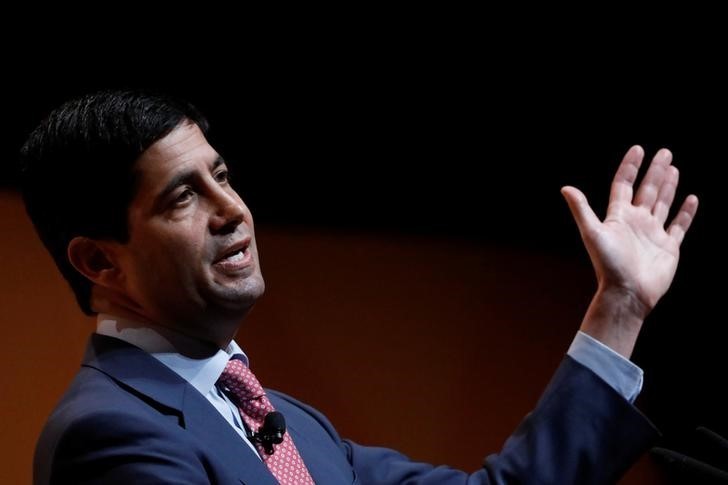


The U.S. Senate on Wednesday confirmed Kevin Warsh as the new chairman of the Federal Reserve, taking the helm of the central bank at a highly sensitive time, as U.S. President Donald Trump continues to push for lower interest rates, while recent inflation data makes that path more complicated.
In the most divisive vote in the history of Federal Reserve chair appointments, Warsh, 56, received Senate approval to succeed Jerome Powell, who has held the position since 2018 and whose term officially ends on Friday.
The Federal Reserve Board voted 54-45 to confirm Warsh, concluding a months-long process that began in the summer of 2015 and involved an intense search for a successor to Powell. The vote was largely along party lines, with the exception of Pennsylvania Democratic Senator John Fetterman, who joined Republicans in supporting the new nominee, making Warsh the 11th Federal Reserve Chair in the modern era.
Powell remains within the institution, and Trump awaits an interest rate cut.
Despite the end of his term as chairman, Jerome Powell will remain a member of the Federal Reserve Board of Governors, as he still has two years remaining in his current term. He stated last month that he would continue his work at least until the investigation into the renovation of the central bank's headquarters in Washington is concluded.
Powell's continued service on the board is a rare occurrence, as no former Federal Reserve chairman has returned to the board in nearly 80 years.
Trump made no secret of his expectation that Warsh would work to lower interest rates, having repeatedly criticized Powell for what he considered an overly tight monetary policy. Warsh was one of about a dozen candidates considered during the selection process, including current governors Christopher Waller and Michele Bowman.
White House spokesman Kosh Desai said the Senate's confirmation of Kevin Warsh was a welcome step toward restoring accountability, competence, and confidence in the Federal Reserve's decisions.
High inflation restricts room for maneuver.
Warsh's appointment came in the wake of data showing that inflation rates remain well above the Federal Reserve's target of 2%, with price pressures in the production stages accelerating to their highest levels in more than three years.
These developments have led markets to reduce their bets on interest rate cuts in the coming period, and investors have even begun pricing in the possibility of another interest rate hike before the end of the year.
Republican Representative French Hill praised Warsh's experience in combating inflation, stressing that the new president has repeatedly emphasized the need to put purchasing power and price stability at the heart of the American economic agenda.
He added that Warsh's commitment to a disciplined monetary policy would boost confidence in the U.S. economy and support long-term prosperity.
Return to the Federal Reserve after years of criticism
This appointment marks Warsh's second return to the Federal Reserve, having previously served as governor between 2006 and 2011, a period that witnessed the global financial crisis and the subsequent unprecedented interventions to save the American economy.
During that period, he was among the voices criticizing the massive expansion of the asset purchase program, known as quantitative easing, which inflated the Federal Reserve's balance sheet to more than $4 trillion.
Since leaving the central bank, Warsh has continued his criticism of monetary policy, culminating last year in a television interview where he called for a radical change in the institution's approach. He has also lectured at Stanford University's business school and served on several boards of directors.
Rich background and first test in June
Warsh replaces Stephen Miran on the Federal Reserve Board, the governor who was appointed in September 2025 to complete the remainder of Adriana Kuegler's term after her surprise resignation in August.
Miran had gone against the Open Market Committee’s direction in almost all of its meetings, calling for larger interest rate cuts in 2025 and opposing decisions to hold interest rates steady during 2026, demanding an additional quarter-point cut.
Warsh is scheduled to chair his first meeting of the Federal Open Market Committee on June 16 and 17, a meeting that will be closely watched globally for his first signals on the future of interest rates.
Warsh will also go down in history as the richest Federal Reserve chairman ever, with a fortune exceeding $100 million, and will be required to divest from a large number of his investments in compliance with strict ethical rules recently adopted to promote transparency and prevent conflicts of interest within the US central bank.
Can the new Federal Reserve chairman lower interest rates and fulfill Trump's dream?
Cutting interest rates will not be an easy task for Kevin Warsh, the new chairman of the Federal Reserve, as the US central bank's appetite for implementing the rapid reduction demanded by President Donald Trump appears very limited.
Trump recently stated that he would be disappointed if Warsh was unable to deliver an interest rate cut soon, a clear indication of the amount of political pressure awaiting the new president from his first day in office.
But Warsh stressed during his confirmation hearing before the Senate that he had made no commitment to Trump regarding his ability to lower interest rates, explaining that his vision for leading the Federal Reserve goes beyond simply responding to short-term political demands.
Warsh believes the main problem facing the Federal Reserve is its excessive preoccupation with the daily fluctuations of economic data, at the expense of a more important goal: restoring the confidence of markets and the public in the central bank's ability to control inflation.
In his view, the clearest evidence of this declining credibility is seen in inflation expectations, as both investors and consumers do not expect inflation to return to the target level of 2% even within the next five years.
In order to change these expectations, Warsh intends to reduce the Federal Reserve's reliance on what is known as forward guidance, that is, providing advance signals about the expected path of interest rates.
It also plans to reformulate its communication strategy so that the central bank speaks with a more consistent voice, update the data sources it relies on in its decisions, and formulate a new understanding with the US Treasury Department regarding the division of roles in managing the economy.
Markets are not betting on an imminent cut
Despite the ambitious reform plans, financial markets do not seem convinced that Warsh will be able to lower interest rates this year.
According to the interest rate forecast tracking tool available on Investing Saudi Arabia’s website, the probability of an interest rate cut this year is only 1%, reflecting an almost complete conviction that high inflation will prevent any easing move in the near future.
This means that the new president may quickly find himself facing high political expectations, at a time when economic and financial conditions are imposing strict limits on his room for maneuver.
There is a real possibility that Trump will be furious if the June meeting does not result in any interest rate cut. But this scenario assumes Warsh will take a negative stance, while the other possibility is that he will succeed in convincing the president that maintaining the Federal Reserve's credibility is the safest path to achieving the economic prosperity the White House seeks.
Trump has demonstrated on numerous occasions his willingness to quickly change his positions when advice comes from someone he trusts, which may give Warsh room to influence rather than engage in direct confrontation.