



































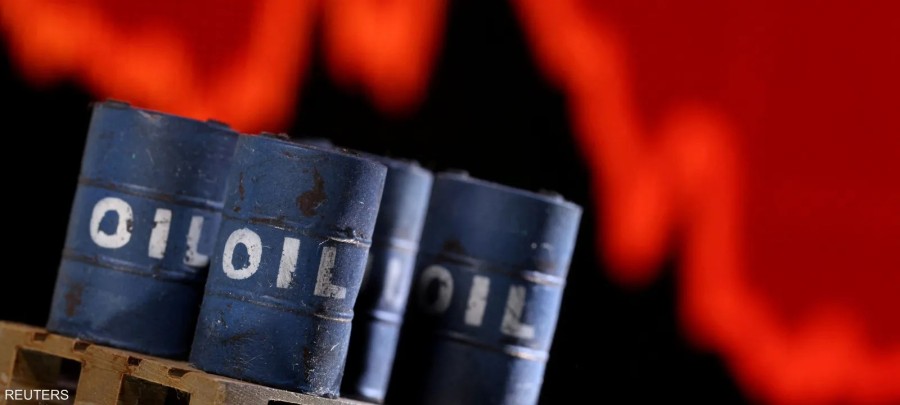


Oil prices fell for a fourth day, heading for their longest losing streak since June, as traders monitored diplomatic efforts to end the trade war between the United States and Iran, and signs that shipments were still crossing the Strait of Hormuz.
Brent crude fell towards $101 a barrel, while West Texas Intermediate crude dropped to trade at around $98.
In an interview with Fox News, US President Donald Trump said he would likely be open to meeting his Iranian counterpart, Masoud Pezeshkian, on the sidelines of the United Nations General Assembly in New York this week.
Trump is also scheduled to hold a summit with Chinese President Xi Jinping, and may meet with officials from the Gulf Arab states on the sidelines of the United Nations meeting.
Energy flows through the Strait of Hormuz are at their highest level in six months.
Crude oil and liquefied natural gas flows through the Strait of Hormuz reached their highest level in six months over the past two weeks, according to Admiral Brad Cooper, commander of U.S. Central Command.
In a video message, he said that the main transit routes in the waterway are free of mines, and that US allies in the Arabian Gulf have shipped more than 1 billion barrels of crude oil through it in the past two months.
Xu Zhao, senior oil analyst at Guotai Junan Futures, told Bloomberg: “The market is moving from a phase of deteriorating supply conditions to one where the worst of the shortage may be over.” She added that despite this, Brent crude is likely to hold around $100, as the conditions for a sustained downward trend are not yet in place.
Houthi attacks and disruption of East-West
Brent crude remains up about 70% this year, after the war disrupted flows through the Strait of Hormuz and Ukraine continued shelling Russian energy infrastructure. Oil products, such as diesel, have risen at a faster pace than crude oil, further fueling inflationary pressures.
Security risks remain high, after the coalition supporting legitimacy in Yemen announced on Saturday that Saudi air defenses intercepted and destroyed a ballistic missile launched by the Houthis towards Riyadh.
Coalition spokesman Turki al-Maliki said that defenses also thwarted attempts to target Bish, Taif, Farasan and Yanbu.
In the oil market, traders are watching for signs that Riyadh is making progress in restoring operations on the East-West pipeline, which runs to the Red Sea and was shut down as a precaution after drone attacks.
In response, Saudi Aramco increased its shipments from the Ras Tanura terminal on the Gulf to compensate for some of the supplies lost due to the pipeline shutdown.
Data from Kpler showed that the volume of Saudi oil loaded from the port doubled to an average of about 3 million barrels per day during the second week of September, compared to about 1.5 million barrels per day in the first week.
Attack on Moscow refinery
Away from the Middle East, Moscow's oil refinery was hit in drone attacks that constituted the largest Ukrainian attack in a single night this year.
Kyiv continues to target Russian energy infrastructure in a campaign that has contributed to shortages in fuel markets, particularly diesel.
The Iran-Ukraine war has intensified global inflationary pressures as energy prices have risen, prompting the Federal Reserve to raise interest rates last week.
Minneapolis Federal Reserve President Neel Kashkari said inflation remains too high and that pressures have widened beyond the oil price shock.
US retail diesel prices have surpassed $6.50 a gallon for the first time, continuing a war-driven upward trend whose repercussions extend across the economy.
The national average price of a car reached $6,505 as of Saturday, according to the American Automobile Association. The pace of increases accelerated in September, with prices rising by more than 87 cents since the beginning of the month, climbing almost daily and far exceeding the peak recorded in 2022.
Latest price movements
Brent crude for November delivery fell 2% to $101.73 a barrel at 11:09 a.m. in Singapore.
West Texas Intermediate crude for October delivery fell 2% to $98.25 a barrel.