





























A global sell-off in bonds intensified, confusing investors, as strong US economic data and weak demand at a debt auction pushed Treasury yields across most maturities to their highest levels in nearly two decades.
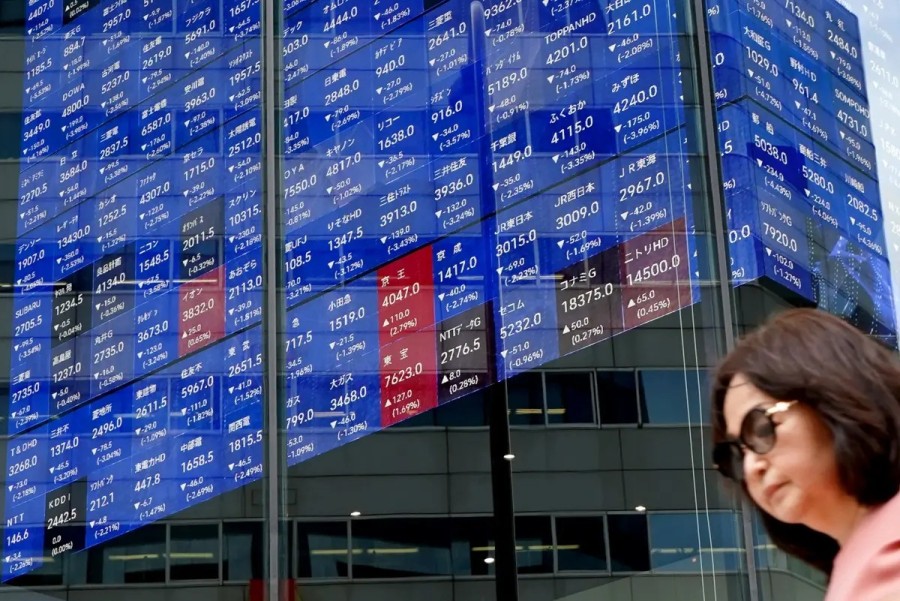
The sharp losses on Wall Street spread to the Asia-Pacific region, with bonds in Japan, Australia, and New Zealand also declining. The yield on the benchmark 10-year US Treasury note settled at 5.12% during Asian trading, after jumping 15 basis points on Wednesday, its biggest increase since the turmoil triggered by President Donald Trump's tariff announcement in April 2025.
Weak demand at a five-year bond auction pushed its yield above 5% for the first time since 2007. The 30-year Treasury yield approached 5.44%, its highest level in more than two decades. The Bloomberg Dollar Index hovered near levels last seen in July, as traders priced in further interest rate hikes by the Federal Reserve.
Despite some relief from oil, with Brent crude paring Wednesday's gains and trading down 0.9% at around $102.20 a barrel, stocks barely benefited. Asian shares followed Wall Street's decline, while futures contracts for stock indices indicated the potential for losses to extend to Europe as well.
Bets on further US interest rate hikes
The likelihood of rising energy costs coinciding with a continued strong US economy increases pressure on the bond market, which is already experiencing turmoil due to weak auction demand and concerns that interest rates will remain high.
With Treasury yields surging and the average yield on global government debt dangerously close to 4%, traders have increased their bets on further monetary tightening by the Federal Reserve, following its first interest rate hike since 2023 last week.
Tony Miano of the Wells Fargo Investment Institute said: “This is a message from the market that we’ve entered a real tightening cycle again.” He added: “All maturities on the yield curve are being repriced simultaneously, which means higher discount rates used to value stocks, higher mortgage and corporate borrowing costs, and a higher threshold that risky assets must cross.”
Swap contracts are now fully priced in three quarter-point rate hikes over the next year, with significant hedges for a fourth. If this occurs, the central bank's target interest rate range will rise to between 4.75% and 5%.
Officials raised borrowing costs last week to a range of 3.75% to 4%, a move Federal Reserve President Kevin Warsh said removed some of the monetary easing. Federal Reserve Governor Michael Barr said further interest rate hikes would likely be needed to bring inflation back to the central bank's 2% target.
Chinese stocks fall despite trade truce extension
In other sectors of the market, gold held onto the losses from the previous session, with the precious metal falling 1.7% to around $4,290 an ounce. The appeal of this non-yielding asset diminishes as interest rates rise.
Stocks in mainland China fell by more than 1%, even as U.S. Treasury Secretary Scott Bisent announced that the United States and China had agreed to extend their trade truce for two months.
US diesel futures jumped as the Trump administration worked with refiners to voluntarily limit exports of the product, as an alternative to imposing a complete ban on shipments abroad.
Some analysts said the US-China agreement to extend the trade war truce until January 10 removes an immediate source of uncertainty, but tangible progress is needed to dispel the pressures that still hang over the market.
In Japan, the yield on 10-year bonds rose to its highest level since 1996. Its Australian counterpart recorded its biggest increase in nearly two weeks, while the New Zealand yield for the same term recorded its biggest jump since early March.
Interest rate trajectory returns to the forefront of attention
The sharp rise in yields has brought the Federal Reserve's interest rate path back into the spotlight.
In projections released after last week's decision, officials anticipated another rate hike before the end of the year, according to the median estimate. The median estimate for 2027 showed no further increases next year, although eight officials predicted that the benchmark interest rate would end that year half a percentage point higher than its current level.
“After the monetary policy meetings, there was a sense that bond yields might stabilize, so the recent surge seems too rapid,” said Eiko Mitsui, a fund manager at Aizawa Securities Co. “However, yields are now at quite attractive levels, and bond investors may now start looking for opportunities to put their money to work.”