































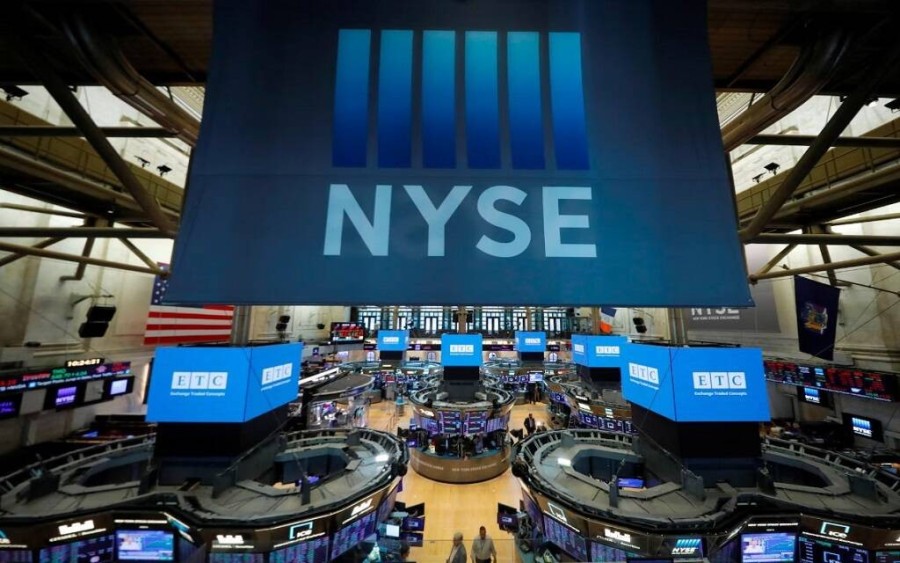


Stocks fell for a second straight session on Friday, ending a losing week for Wall Street, as investors digested sharp swings in semiconductor stocks and a flurry of quarterly results.
The S&P 500 fell 1.01% to close at 7,457.69, while the Nasdaq Composite dropped 1.4% to 25,520.24, with technology stocks bearing the brunt of the sell-off. The Dow Jones Industrial Average shed 406.55 points, or 0.77%, to close at 52,146.42. Semiconductor stocks, which had been the main driver of recent market gains, led the decline at the start of the session before the sell-off widened.
For the week, the S&P 500 fell 1.6%, the Nasdaq dropped 2.9%, and the Dow Jones lost 0.9%. The Philadelphia Semiconductor Index recorded its worst weekly performance in over a year, plummeting more than 18% this month alone.
Tech giants' second-quarter earnings are on the agenda
U.S. stock futures edged higher on Monday following last week's declines, as investors awaited a busy quarterly earnings season expected to test the market's AI-driven momentum. Overall sentiment remained cautious amid escalating tensions in the Middle East.
The pace of second-quarter earnings season is set to accelerate this week with the release of results from Alphabet, Tesla, Intel, IBM, and other major companies. These results are expected to give investors deeper insight into the spending plans of leading AI providers, spending that has been a cornerstone of the market's performance this year, supporting semiconductor and AI infrastructure stocks and helping propel major indexes to record highs.
If the anticipated results indicate that AI infrastructure is still in the stage of intensive spending, investors may lose patience, potentially extending the recent downturn throughout the summer.
The second-quarter earnings season is still in its early stages, with 49 companies in the S&P 500 having reported their results so far. Of these, 90% have exceeded analyst expectations, according to LSEG data. Analysts now expect S&P 500 earnings to grow 26.0% year-over-year, a sharp increase from the 19.2% forecast on April 1, LSEG data shows.
What analysts are saying about US stocks
Yardeni: The S&P 500 reached 7,500 for the first time on May 14th and has remained stuck near this level. The index continues to trade along its 50-day moving average. A 6.0% decline would take it back to its 200-day moving average. We have seen this scenario before, most recently in late 2024 and early 2025, and again in late 2025 and early 2026, both times with similar horizontal consolidation followed by a pullback that attracted bargain hunters. We believe this scenario is likely through September. We still target 8,250 by the end of this year.
Morgan Stanley : Our expansion thesis continues as the index struggles to gain ground and previous leaders falter. This shift in leadership is likely to persist and could lead to further consolidation in the major indices before the bull market resumes its upward trajectory in earnest.
We still prefer shares of major AI service providers over semiconductor stocks over the next few months... However, we acknowledge that the risk-to-reward ratio has become less attractive after a relative outperformance of nearly 30% in just three weeks.
advertisement
Evercore ISI : The post-pandemic era has ushered in a bold new world. For investors, this new world doesn't signify the end of the US stock market's bull run. None of the elements of a final break are in sight—no recession, the Federal Reserve is hesitant to raise interest rates, long-term yields are stable, and there's no widespread fear of missing out. Volatility in tech stocks remained high throughout the boom of the 1990s, even as pullbacks became the norm, particularly in the bullish second half of 1999, which closely resembled price movements since the market bottom on March 30th during the summer of 2016.
JPMorgan Chase & Co .: We are in favor of rotation and expansion in the second half of the year... and maintain our medium-term concerns about monetization from the massive rise in capital expenditures of major AI service providers, and remain fundamentally pessimistic about the software, business services and media sectors - the groups where AI is eating away at shares.
However, we do not anticipate a prolonged market downturn as a result of these market movements. We believe that various AI companies should not experience a significant decline in absolute value for an extended period, given their continued strong earnings growth and rising valuations. In particular, semiconductor stocks should soon find buyers.
RBC Capital Markets : Our valuation analysis is not yet sending a clear reversal signal, although some of our charts suggest that the rotation is in its later stages. With the current sideways movement in relative performance between US and non-US stocks, along with the return of relative performance between growth and value, between high and low price momentum, and between the top 10 companies and the rest of the S&P 500 constituents to levels close to previous reversal points where they attempted to stabilize, we remain on alert for a potential shift towards leading growth stocks with large market capitalizations.