




















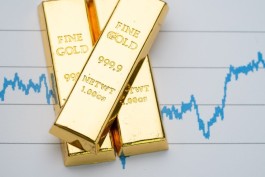
















Gold prices stabilized during trading on Monday, after some investors resorted to buying the precious metal following its decline to its lowest level in more than a month and a half, amid rising inflationary fears that sparked a broad sell-off in global bond markets.
Oil and revenues are putting pressure on the precious metal.
Oil prices rose to their highest level in two weeks after a drone attack caused a fire inside a nuclear power plant in the United Arab Emirates, Emirati authorities announced on Sunday.
Meanwhile, the yield on 10-year US Treasury bonds climbed to its highest level since February 2025, while the yield on 10-year Japanese government bonds reached levels not seen since October 1996.
Kelvin Wong, senior market analyst at OANDA, explained that the sell-off in long-term US bonds suggests the likelihood of continued high long-term interest rates, which indirectly increases the cost of holding gold, which does not provide a periodic return for investors.
Expectations of an interest rate hike are pushing gold prices down the road.
Market bets have increased on the possibility that the US Federal Reserve will raise interest rates before the end of the year, with the probability of this move by December reaching 50%, according to the US interest rate monitoring tool available on Investing Saudi Arabia.
Higher interest rate expectations typically put pressure on gold, as investors prefer assets that provide a steady return when interest rates rise.
In this context, JPMorgan Chase lowered its forecast for the average price of gold during 2026 to $5,243 per ounce instead of $5,708, citing weak demand for the precious metal in the near term.
JP Morgan: Gold stuck in a foggy technical zone
The US bank explained that gold is currently moving in a technically unclear direction, as it is settling above the 200-day moving average at around $4,340 per ounce, but is facing strong resistance below the 50-day moving average at $4,730.
The bank believes that expectations of tighter US monetary policy have pushed gold down the priority list for many investors at the moment.
This means that the precious metal may remain under pressure until interest rate expectations change or new catalysts emerge that restore demand for safe-haven assets.
Gold at settlement on Friday
Gold prices fell at the close of trading on Friday, coinciding with a rise in global sovereign bond yields and a strengthening dollar, amid increasing inflationary risks due to the ongoing conflict in the Middle East.
Gold futures fell by about 2.6% to $4,561 an ounce, with losses reaching 3.5% over the past week.
Gold today
Spot gold settled at $4,536.45 an ounce, after earlier hitting its lowest level since March 30.
In contrast, US gold futures for June delivery fell 0.5% to $4,539.90 an ounce, reflecting continued pressure on the metal despite some buying at lower levels.
Other precious metals are also declining
The pressure wasn't limited to gold alone, as spot silver fell 1.3% to $74.98 an ounce.
Platinum also fell by 0.5% to $1,963.88 an ounce, and palladium dropped by 1.2% to $1,396.14 an ounce.